Apple Watch 7 e Fitness+: connubio perfetto per la palestra in casa. La recensione
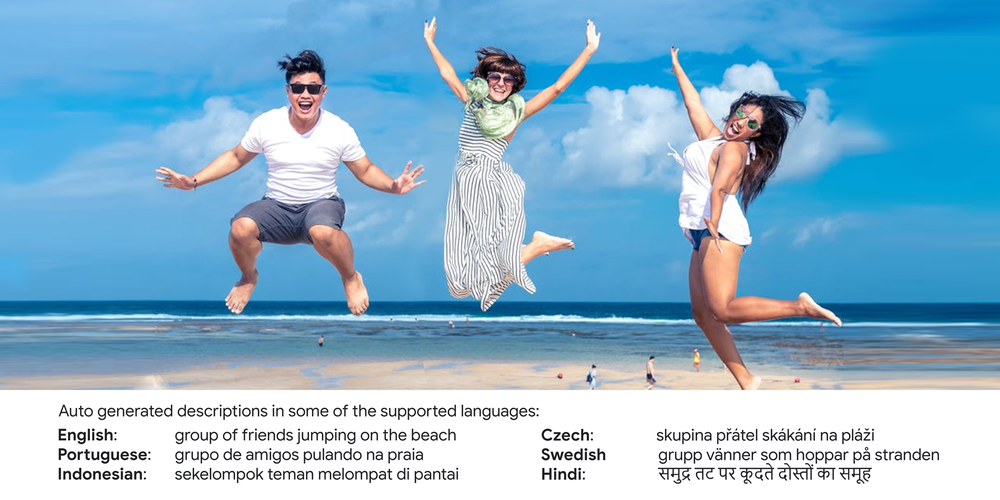
More accessible web images arrive in 10 new languages
Images can be an integral part of many people’s online experiences. We rely on them to help bring news stories to life, see what our family and friends are up to, or help us decide which couch to buy. However, for 338 million people who are blind or have moderate to severe vision impairment, knowing what’s in a web image that isn’t properly labeled can be a challenge. Screen reader technology relies on the efforts of content creators and developers who manually label images in order to make them accessible through spoken feedback or braille. Yet, billions of web images remain unlabelled, rendering them inaccessible for these users.
To help close this gap, the Chrome Accessibility and Google Research teams collaborated on developing a feature that automatically describes unlabelled images using AI. This feature was first released in 2019 supporting English only and was subsequently extended to five new languages in 2020 – French, German, Hindi, Italian and Spanish.
Today, we are expanding this feature to support ten additional languages: Croatian, Czech, Dutch, Finnish, Indonesian, Norwegian, Portuguese, Russian, Swedish and Turkish.
The major innovation behind this launch is the development of a single machine learning model that generates descriptions in each of the supported languages. This enables a more equitable user experience across languages in the sense that the generated image descriptions in any two languages can often be regarded as translations that respect the image details (Thapliyal and Soricut (2020)).
Auto-generated image descriptions can be incredibly helpful and their quality has come a long way, but it’s important to note they still can’t caption all images as well as a human. Our system was built to describe natural images and is unlikely to generate a description for other types of images, such as sketches, cartoons, memes or screenshots. We considered fairness, safety and quality when developing this feature and implemented a process to evaluate the images and captions along these dimensions before they’re eligible to be shown to users.
We are excited to take this next step towards improving accessibility for more people around the world and look forward to expanding support to more languages in the future.
To activate this feature, you first need to turn on your screen reader (here’s how to do that in Chrome). From there, you can activate the “Get image descriptions from Google” feature either by opening the context menu when browsing a web page or under your browser’s Accessibility settings. Chrome will then automatically generate descriptions for unlabelled web images in your preferred language.

Why content bundling is the secret sauce for creators
If you make online video content, you’ve probably heard of VidCon, an event where creators, brands, industry experts and fans from around the world converge to celebrate the latest and greatest in digital media. The next VidCon takes place December 3-6 in Abu Dhabi featuring panel discussions, meet and greets and performances with some of the world’s most influential video content creators.
Google for Creators will speak at two sessions at VidCon Abu Dhabi, both of which will focus on helping creators build their brands and monetize their content. On December 3, Head of Creator Relations at Google Paul Bakaus and cosplay designer Yaya Han will discuss how creators can have more control over their futures and businesses. Later that day, Google for Creators writer Crystal Lambert and creator Kaya Marriott will speak at Get the Most from Your Post — How to Create Powerful and Efficient Content Bundles.
On the Google for Creators team, Crystal writes the educational guides for Creators.google. A liaison between the creator community and Google’s expert sources, Crystal researches, compiles and organizes vast troves of information into digestible, easy-to-follow and fun-to-read guides.
We spoke with Crystal to hear more about her upcoming VidCon appearance, and why content bundling is such an important strategy for creators.
Why focus on content bundling at VidCon?
We’re giving two talks at VidCon, and we wanted to focus both of them on the biggest needs in the creator economy. What we’ve learned from creators is that many want to know how to continuously make content without burning out. Content bundling — creating multiple pieces of content on one topic for different formats and platforms — is about tackling content creation in a holistic way. It’s not about approaching all these platforms as individual entities, but grouping what you’re doing together and building on it. It’s one of the easiest and most effective things a creator can do. It’s about content strategy, cross promotion and dealing with brands. Content bundles give you more visibility as a business and credibility when you reach out to brands, or when brands reach out to you.
Who is your VidCon co-presenter?
Kaya Marriott is the founder and content creator behind lifestyle and beauty blog Comfy Girl with Curls. I was super excited to connect with her because she’s on her way to becoming a successful, full-time content creator, and her journey has been so inspiring. She started Comfy Girl with Curls as a natural hair blog, but because so many other creators have come to her for advice, she also shares tips about creating content.
Kaya’s built her own business and she’s been very proficient and proactive about it. She brings a lot of credibility and first-hand knowledge about how and why content bundles work. We’re both excited to speak together.
What else are you excited to see at VidCon?
VidSummit was the first creator-geared conference I went to, and it was inspiring to see how helpful the video creator community is and how enthusiastic they are about what they do. They’re willing to help other creators by teaching them what they’ve learned. I’m excited to see that community at VidCon.
I’m also excited to experience VidCon in another country. I’ve never been to Abu Dhabi, and I’m looking forward to seeing who will be there and what the Abu Dhabi creator community is like.
If you won’t be in Abu Dhabi for VidCon, learn more about content bundles and cross promotion on Creators.google and the Google for Creators YouTube channel.
How we’re testing Project Starline at Google
This May at Google I/O 2021, we shared our vision for Project Starline, a technology project that combines advances in hardware and software to enable friends, families and coworkers to feel together, even when they’re cities (or countries) apart.
Project Starline is the culmination of advances we’ve made across 3D imaging, real-time compression, spatial audio and our breakthrough light field display system that, when combined, enables a sense of depth and realism that feels like in-person communication. We recently described some of these advancements in a technical paper, Project Starline: A high-fidelity telepresence system, which we’re honored to have had accepted for publication at SIGGRAPH Asia.
As we’ve started expanding Project Starline’s availability in more Google offices around the United States, we’ve been encouraged by the promising feedback. Google employees have spent thousands of hours using Project Starline to onboard, interview and meet new teammates, pitch ideas to colleagues and engage in one-on-one collaboration. Many users noted how powerful the ability to make eye contact was, and how much more engaged and connected they felt. One user compared their experience to a coffee chat – a genuine interaction that makes you want to lean in and focus on the other person.
We measured the impact of hundreds of Google employees’ experiences with Project Starline, and the results showed that it feels much closer to being in the same room with someone than traditional video calls. We saw an increase in some of the most important signals that are often lost in video calls, such as attentiveness, memory recall and overall sense of presence. Here’s what we found when comparing Project Starline to traditional video calls:
- People displayed more non-verbal behaviors such as ~40% more hand gestures, ~25% more head nods and ~50% more eyebrow movements.
- People had much better memory recall when using Project Starline, tracking nearly ~30% better when being asked to recall details of their conversation or the content of a meeting.
- People focused ~15% more on their meeting partner in an eye-tracking experiment, suggesting that visual attentiveness is enhanced when using Project Starline.
These early results show promise for Project Starline’s ability to facilitate more personal connections from afar. As Google and more companies navigate the future of work, we are optimistic about the potential to deepen connection and collaboration among employees in the modern-day workplace. We look forward to continuing to expand Project Starline and sharing more on our progress.

Training the next generation of Android developers
Pictured left to right: Natalia Villalobos, Omoju Miller, Laura Markell and Kat Kuan
In 2015, Developer Advocate Kat Kuan and I took a walk around the marshlands of Google’s Mountain View campus. We asked ourselves, “Why aren’t there more people of diverse backgrounds building apps for Android?” We noticed that the Android training content offered at the time assumed an intermediate level of programming experience, and decided to challenge that assumption. Was it possible to learn Android without any programming experience? We set out to create a learning path that would enable anyone to become an Android developer, and this remains one of the main priorities for Android’s training content.
As a team of four women at Google with different backgrounds and experiences, we envisioned what this learning process could entail and conducted early user testing to make sure student needs were met. In partnership with Udacity, we co-developed a curriculum for Android beginners. We focused on not only delivering technical content, but also on crafting supplemental materials like app case studies, an easy-to-understand vocabulary glossary and inspiring video content to reduce imposter syndrome. In 2015 the Android for Beginners course launched, and we saw tremendous reception. Soon students were asking, “What’s next?” We expanded the curriculum into a series of courses to help people without programming experience build a collection of Android apps. This was a major step towards building a more inclusive, equitable Android developer ecosystem.
In the six years since, Google continues to grow its investment with a larger dedicated training team. We’re seeing even more demand for beginner Android training, particularly as there are now over 3 billion active Android devices in the world. With a platform that evolves as quickly as Android, making sure learners have access to up-to-date materials that reflect development best practices is a major priority.
The latest course is Android Basics in Kotlin, available now for people with no programming experience who want to build basic Android apps within the flexibility of their own schedule. Beyond this online curriculum, we created materials for different learning styles so everyone can learn these critical Android concepts. To support students who learn best with others, we have facilitator materials that are useful for a group setting. To support more traditional classroom learning, we offer a university classroom curriculum that educators can adapt for their teaching environments. Next up, we are working on a training course in Compose, which is Android’s latest toolkit for building user interfaces.
Since that very first conversation that sparked the idea for this initiative, it was always about wanting to empower people. To date, hundreds of thousands of students have started their Android training. It has been incredible to witness their growth — both in the skills they acquire and the confidence they gain.
But we’re not done asking the hard questions. We’re still challenging our assumptions, and we’re as committed as ever to enabling more people to build products that reflect their diverse experiences. This not only unlocks new career paths for people, but it results in a better app ecosystem — one that serves more people, and creates new opportunities.
To stay up-to-date on the latest news in Android training, check out the Android Developers blog.

Ask a Techspert: What exactly is a time crystal?
Quantum computers will allow us to do hard computations and help us rethink our understanding of the fundamentals of science. That’s because quantum computers harness the power of quantum mechanics — a subfield in physics that explains how the natural world around us works at the subatomic level. While we are a long ways off from building a useful quantum computer, our team at Google Quantum AI is already running novel experiments on the quantum processors we have today. One particular experiment that was just published in the science journal Nature is our work on a new phase of matter called a time crystal.
For years, scientists have theorized about the possibility of a time crystal and wondered whether one could ever be observed. By using our quantum processor, Sycamore, we now know it’s possible. To answer some common questions about this phenomenon, Google Quantum AI research scientists Pedram Roushan and Kostyantyn Kechedzhi answer the frequently asked questions.
What is a time crystal?
A time crystal may sound like it’s from the pages of a science fiction novel, but it’s something that we’ve demonstrated is possible to observe, even though it may appear to go against the basic laws of nature. You might be familiar with crystals like emerald, diamond and salt. At the microscopic level, they’re made up of repeating patterns — many layers of atoms that ultimately form a physical structure. For example, a grain of salt is made up of sodium and chlorine atoms. A time crystal is similar, but instead of forming a repetitive pattern in space, an oscillating pattern is formed in time.
Time crystals show an oscillating pattern in time.
Can you give an example of a time crystal?
Let’s say you took pictures of a planet and its orbiting moon every time it finishes its orbit over a period of time with the Hubble Telescope. These pictures would all look the same with the moon repeating its orbit over and over again. Now hypothetically, let’s say there were hundreds of new moons added to the planet’s orbit. Each new moon introduced would exert gravitational pull on the orbits of the others. Over time, the moons would start to deviate from their orbits without ever coming back to their starting point. This increase in disorder or entropy is unavoidable due to the second law of thermodynamics, a fundamental law of physics. What if there was a system of a planet and many moons where the moons could periodically repeat their orbits, without ever increasing entropy? This configuration — evidently hard to achieve — would be considered a time crystal.
How do you use a quantum processor to observe a time crystal?
Quantum objects behave like waves, similar to how sonar uses sound waves reflected from solid objects on the ocean floor to detect them. If the medium that the quantum wave travels through contains multiple objects at random locations in space, then the wave could be confined and come to a complete stop. This key insight about quantum waves is what puts a cap on the spread of entropy and allows the production of a stable time crystal, even though it appears to be at odds with the second law of thermodynamics. This is where our quantum processor comes in. In our paper, we describe how we used our Sycamore processor as a quantum system to observe these oscillatory wave patterns of stable time crystals.
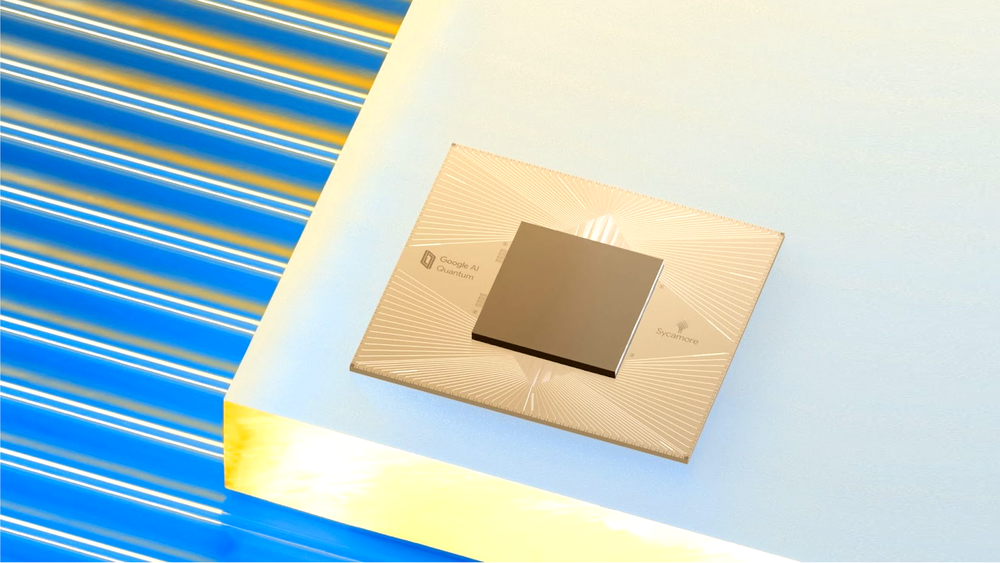
We observed a time crystal using Sycamore, our quantum processor.
Now that time crystals have been observed for the first time, what’s next?
Observing a time crystal shows how quantum processors can be used to study novel physical phenomena that have puzzled scientists for years. Moving from theory to actual observation is a critical leap and is the foundation for any scientific discovery. Research like this opens the door to many more experiments, not only in physics, but hopefully inspiring future quantum applications in many other fields.

Come regalare un buono per Netflix ad amici e parenti
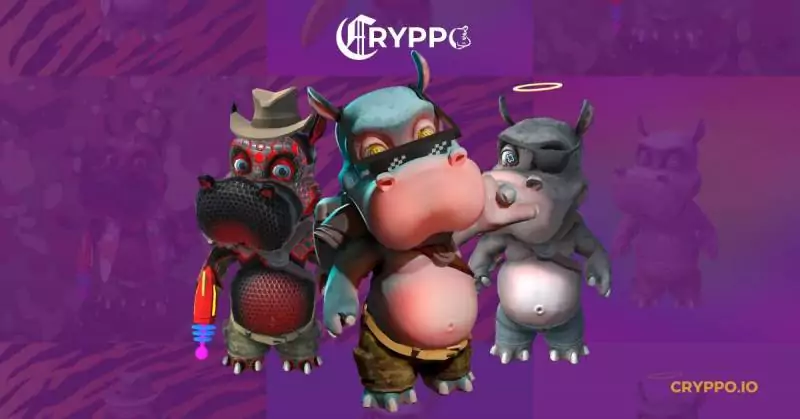
Ecco Cryppo, la Mascotte NFT di Cryptonomist con tanto di DAO e metaverso
Venite a scoprire le avventure in 7.777 token non fungibili e a conoscere il primo ippopotamo cryptonomus The Cryptonomist sta lanciando la sua serie di NFT dedicata a Cryppo, il…
L’articolo Ecco Cryppo, la Mascotte NFT di Cryptonomist con tanto di DAO e metaverso scritto da YOUR_DIGITAL_VOICE! proviene da Assodigitale.
News Showcase is launching in Portugal
Google News Showcase, a product and licensing program for news publishers, will begin rolling out in Portugal today as “Destaques Jornalísticos no Google” in Portuguese. Participating publishers from local, national and independent Portuguese outlets can give readers more insight into the topics they choose to highlight, through curated story panels which can appear on Google News and Discover.
This is part of our global investment in news and reinforces our commitment to Portugal and journalism. With News Showcase (Destaques Jornalísticos), publishers can provide additional context about stories via curated panels, and add related articles, timelines and more. Publishers get more control of their presentation and branding, helping them be more visible to their dedicated readers and to those who are just discovering them.
Google has signed partnerships with 28 Portuguese publications, including O Jornal Económico, Jornal de Notícias, Observador, O MIRANTE and Jornal do Fundão. News Showcase (Destaques Jornalísticos) panels can appear on Google products, currently on News and Discover, and direct readers to the full articles on publishers’ websites, helping them deepen their relationships with readers. In addition to the revenue that comes directly from these more-engaged readers, participating publishers will receive monthly licensing payments from Google.
Logos of our News Showcase partners
“Quality journalism has a paramount importance in a free and democratic world. It gives everyone the knowledge to play an active role in society as the world evolves, beyond witnessing history,” says Marco Galinha, CEO of Global Media Group, who owns several titles in Portugal, including Dinheiro Vivo, Jornal de Notícias and TSF. “Sharing our quality information, strengthening our audience and connecting even more people is what we expect from Google News Showcase (Destaques Jornalísticos no Google).”
Since News Showcase (Destaques Jornalísticos) launched in October 2020, we’ve signed deals with more than 1,000 news publications around the world and have launched in more than a dozen countries: India, Japan, Germany, Brazil, Austria, the U.K., Australia, Czechia, Italy, Colombia, Argentina, Canada and Ireland. More than 90% of the publications that are part of News Showcase (Destaques Jornalísticos) represent local or community news. Local news is an essential way for readers to connect to their communities and ensure they get the news that impacts their day-to-day lives.
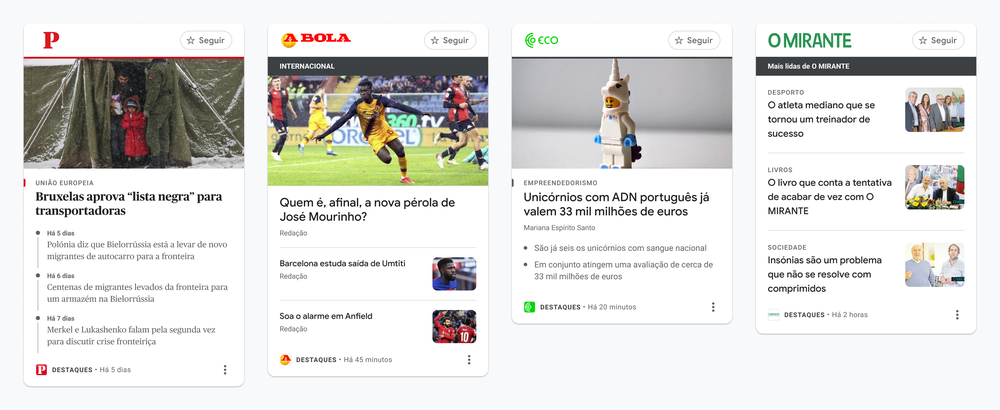
An example of how News Showcase panels will look with some of our partners in Portugal
“A Voz de Trás-os-Montes is a local newspaper, seeking, over time, to reinvent itself in the production of content and the formats in which it is presented, whether on paper or digital.” says João Vilela, Director at A Voz de Trás-os-Montes. “Google News Showcase (Destaques Jornalísticos no Google) assumes itself as a product that will enhance the presence of this title in the digital world, also promoting the practice of quality, reliable and independent journalism, and providing readers with a good experience in accessing regional information.”
To further strengthen these relationships, we offer News Showcase (Destaques Jornalísticos) readers the ability to read select paywalled content from publishers. This feature means readers will have the opportunity to read more of a publisher’s articles, encouraging them to learn more about the publication — and potentially subscribe.
“Earlier this year, we challenged Google and the Portuguese Press Association to work together to find solutions to support a sustainable Portuguese media ecosystem, and in particular the local and regional media, in order to respond to the digital challenges, based on a framework that respects individual rights and copyright and ensures that the Portuguese citizens continue to have access to credible and relevant information”, says André de Aragão Azevedo, Secretary of State for the Digital Transition. “We are proud to see such great progress and we are in full support of initiatives like this.”
Google News Showcase (Destaques Jornalísticos no Google) is our latest effort to support publishers of all sizes and the news ecosystem in the country. Through the Digital News Initiative (DNI) Fund, Google has invested nearly eight million euros to support 32 Portuguese projects, tackling major challenges such as boosting digital revenues to telling local stories and exploring new technologies. In 2020, with the spread of the COVID-19 pandemic, the Google News Initiative offered financial support to 71 Portuguese newsrooms through its global Journalism Emergency Relief Fund. Around the world, the GNI, alongside a $300 million investment, has supported more than7,000 news partners in over 120 countries and territories.
Google also sends eight billion visits each month to European news websites from products like Search and News, which publishers can monetize with online advertising and subscriptions on their websites and apps. Our ad technologies enable news organizations to sell their ad space to millions of advertisers globally — including advertisers they wouldn’t have access to without these services.
Beyond working with publishers on their digital transformation, it’s vital we also support access to accurate and reliable information. Since 2015, the Google News Lab has trained 2,550 Portuguese journalists and journalism students on a range of digital tools to help them research, verify and visualize their stories. We’ve also supported a number of Portuguese specialists including Media Veritas, a project by the Portuguese Press Association to promote media literacy and combat misinformation, and we contributed 25 million euros to the European Media and Information Fund, managed by the Calouste Gulbenkian Foundation, European University Institute and the European Digital Media Observatory to strengthen media literacy skills.
“Rather than a threat, digital can be an opportunity for publishers. This is why APImprensa is supporting its members (regional and local) to deploy all the advantages of participating in the Google Showcase project,” says João Palmeiro, President of thePortuguese Publishers Association. “The advantages are a unique opportunity to understand how to compete in the digital world using tools that can bring more information, knowledge and skills to newsrooms and to the digital business.
Google News Showcase (Destaques Jornalísticos no Google) helps readers discover even more news and provides publishers with a new online experience to deepen their engagement and relationship with their audience. We are happy to contribute to the news ecosystem, support the open web and continue to provide access to information in Portugal and elsewhere.
Per le festività, Google presenta Nest Moments con Chiara Maci
Preparare una cena durante le feste non è mai stato così divertente, con l’aiuto di Google Nest Hub. Scoprite il delizioso menù di ricette per le feste che Chiara Maci, food blogger e conduttrice televisiva, ha creato in esclusiva per “Nest Moments”, in arrivo oggi su YouTube
“A Natale tutta la famiglia si riunisce intorno alla tavola e si trascorrono bei momenti insieme. Per creare dei ricordi ancora più speciali, ho proposto una serie di ricette del cuore per Nest Moments. Sono piatti semplici, per cui servono pochi ingredienti, ma sono squisiti. Con praticità, ma con tanto amore potrete stupire amici e parenti e perché no, magari divertirvi a ricrearli insieme. In cucina il sorriso e il divertimento sono gli ingredienti principali che non possono mai mancare”
“Le festività natalizie sono uno dei miei momenti preferiti dell’anno e Nest Hub è un alleato n°1 nell’aiutarmi a creare un banchetto indimenticabile per tutti. Dalla preparazione della lista della spesa alla ricerca di nuove ricette su YouTube fino alla creazione dell’atmosfera giusta con musiche e luci a tema, tutto diventa più facile e divertente. Nest Hub è il mio aiuto cuoco preferito!”

PHP 8.1: cosa sono le Fiber
Twinkly Strings (Generation II): l’albero di Natale diventa smart

Mutui a tasso fisso: a che età conviene chiederli
Il mutuo è la tipologia di finanziamento più richiesta, dopo il prestito personale. Si tratta di un finanziamento con cui un soggetto si impegna a rimborsare un’ingente somma di denaro…
L’articolo Mutui a tasso fisso: a che età conviene chiederli scritto da YOUR_DIGITAL_VOICE! proviene da Assodigitale.

A Verona inaugura il nuovo HDemy Design Hub
Una nuova opportunità di aggregazione per la città Si è svolto ieri in via Santa Teresa 2 a Verona l’evento di inaugurazione del nuovissimo Hdemy Design Hub, una nuova opportunità…
L’articolo A Verona inaugura il nuovo HDemy Design Hub scritto da Paolo Brambilla proviene da Assodigitale.

Google Play’s Best of 2021
Today, we announced the winners of Google Play’s Best of 2021, a celebration of apps and games that made positive contributions to culture this year. And to encourage innovation across Google Play, we’ve expanded this year’s awards to apps and games on tablets, plus apps on Wear OS and Google TV. By challenging the norm, introducing unique gameplay features and giving users never-before-seen experiences, Google Play’s Best of winners represent what’s next in app and game development.
Similar to our Best of 2020 winners, apps focused on personal growth were in high demand in 2021. This year’s winners found creative, and often meditative, ways to help users get to know themselves on a deeper level. Balance, which earned our Best App of 2021 award, encourages people to find their center through personalized meditations; Moonly provides tips and guidance based on the lunar calendar; and Laughscape helps people reach a meditative state through laughter.
“We are deeply honored that Google chose Balance as its Best App of 2021,” says Jesse Pickard, Founder and CEO at Elevate Labs. “We built Balance with the individual in mind. No two people are the same, and we wanted to create a personalized mental wellness program that could reflect and support those special differences. I also want to thank our customers for their help in our journey. Your engagement and feedback has allowed us to build a truly wonderful product together.”
Meanwhile, in gaming, Pokémon UNITE won Best Game for its dynamic gameplay and cross-platform experience. We also saw a surge of independent developers creating imaginative and personal gaming experiences. Indie developer George Batchelor brought us Bird Alone, a game that challenges you to become friends with the “loneliest bird in the world.” And in Donut County, developed by Annapurna Interactive, you play as a growing hole in a physics-based puzzle game.
Check out the full list of this year’s U.S. winners below, ranging from large developers to up-and-coming indies. You can also find your specific country’s winners in the Best of 2021 section of the Play Store.
Users’ Choice 2021
- App: Paramount+
- Game: Garena Free Fire MAX
Best App
Best Game
Best of app winners
Best Apps for Good
Best Everyday Essentials
Best for Fun
Best Hidden Gems
Best for Personal Growth
Best for Tablets
Best for Wear
Popular on Google TV
Best of game winners
Best Competitive
- League of Legends: Wild Rift
- MARVEL Future Revolution
- Pokémon UNITE
- Rogue Land
- Suspects: Mystery Mansion
Best Game Changers
Best Indies
Best Pick Up & Play
Best for Tablets
Congratulations again to all of our Best of winners, and a special thanks to our Google Play community for their participation and support. We look forward to seeing what you build next year.