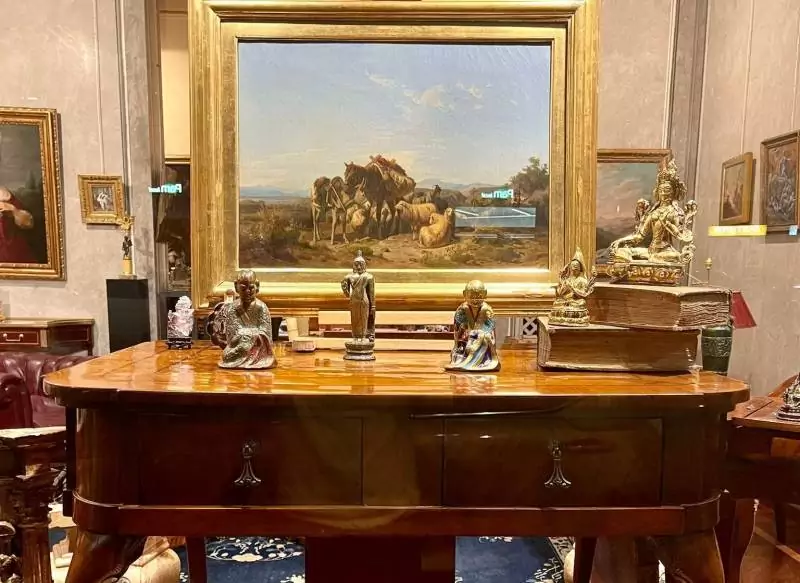
Giuseppe Renga Fine Art: cocktail mercoledi 27 ottobre
Storie Italiane — di Iuliana Ierugan — Giuseppe Renga Fine Art – cocktail e chiaccherata sull’arte mercoledi 27 ottobreGiuseppe Renga inizia la sua professione di antiquario nel 1990, quando ancora…
L’articolo Giuseppe Renga Fine Art: cocktail mercoledi 27 ottobre scritto da Paolo Brambilla proviene da Assodigitale.

Due chiacchiere sull’incertezza dell’esplorazione spaziale al CICAPFest
Il 3 settembre scorso ho fatto una chiacchierata pubblica al ruota libera, nell’ambito del CICAPFest tenutosi a Padova, sul tema dell’esplorazione spaziale e delle sue incertezze. Se vi interessa, c’è un video della chiacchierata: lo trovate qui sotto.
Xbox, via alle offerte natalizie tra hardware next-gen e nuovi titoli
Climate change is humanity’s next big moonshot
Editor’s note: Today, Google GEO Sundar Pichai spoke at YouTube’s Dear Earthevent, sharing ways Google is working to solve climate change — and why he’s optimistic we can make meaningful progress. Below is a transcript of his remarks.
Hello fellow dear earthlings. Thanks for tuning in. I can’t think of another issue that would bring together former President Obama, Pope Francis and BLACKPINK. It’s more proof that climate change is the biggest challenge we face…and it’s one that will affect all of us in deeply personal ways.
You know, there was water scarcity when I was growing up and droughts were frequent events. Over time, the water table became really low and many homes didn’t have access to fresh water. We would have to wait for rationed water to be brought in on trucks, and then wait in long lines to carry water back home.
There were times when the trucks didn’t come at all — and it was all just part of normal life.
Fast forward to 2015, I woke up to the news that Chennai had a 1-in-100 year flood and saw pictures where the whole city was submerged in water. Over two million people were displaced. It really drove home for me, in a personal way, how climate change can impact communities, especially those already facing challenges.
A couple of years after that, I woke up to orange skies and smoke from nearby wildfires in California. It was another reminder how climate change is impacting so many of our communities.
Despite these challenges, I’m still optimistic about our future.
That’s because I believe in people. Throughout history, people have made the impossible, possible. We’ve developed life-saving vaccines, expanded opportunity through the internet and landed on the moon.
Solving climate change is humanity’s next big moonshot.
But unlike the moon landing — there is a clear deadline for action, and severe consequences if we fail.
Yet there’s good news, too: There are more people focused on solving climate change than ever before. From governments and academic researchers, to companies like ours, to people like you.
And your generation is rightfully demanding solutions and holding us to account.
The other bright spot is technology. A lot can change in ten years. Ten years ago most of Google’s energy consumption was from traditional sources. Today, we match 100 percent of our energy with renewable sources.
That shows you what is possible in a decade. And now, we’re focused on the next ten years.
Rather than tell you what we’re doing — let me show you. This is what it looks like inside one of Google’s data centers.
Data centers are what make the internet run. They power the games you stream and the YouTube videos you watch. And they run on about 1% of the world’s electricity, and so changing how that electricity is generated can make a big impact on the other 99%.
That’s why we want to run our data centers on carbon-free energy, 24/7. So, in the future, every search you do, every YouTube video you watch, every Gmail you send will be powered by clean energy — sources like wind, solar, and geothermal. And our goal is to do all this by 2030.
Right now, I’m standing inside our newest building at our headquarters in California. As you can see, it’s still under construction. It will take workspace design and sustainability to a new level. The lumber is all responsibly sourced. And when it rains, we collect the water, treat it and keep it in tanks for future use.
Maybe my favorite thing about this building is the roof. The outside is covered in solar panels that remind me of a dragon’s scales. And it will generate about 40% of the energy the building uses.
Sustainable operations and design can make a big difference. So can people.
Our goal is to find new ways that our products can help one billion people make more sustainable choices in their daily lives. Like choosing the most eco-friendly route home. Or finding the nearest bike share.
These small changes can add up to a big impact — and our planet and your future deserve nothing less.
There will be moments when it feels like progress isn’t fast enough. Or that action isn’t bold enough. So be impatient. That’s what will drive progress. It’s the only thing that ever does.
If you do that, together, we can make sure our planet’s best days are still ahead.

Lucca Comics&Games: tornano gli appuntamenti speciali di Amazon

Twitter estende la funzione Spaces a tutti gli utenti

Chrome rinuncia (definitivamente) ad FTP
HUAWEI nova 9, vi presentiamo la scheda tecnica completa
Advancing public-private partnerships with #ShareTheMicInCyber
We know diverse security teams are more innovative, produce better products and enhance an organization’s ability to defend against cyber threats.
Today, cybersecurity practitioners across Google and industry are elevating the voices and expertise of Black security practitioners as part of #ShareTheMicInCyber’s public and private partnerships campaign.
Amid increasingly sophisticated and dangerous ransomware and supply chain attacks on critical infrastructure and private sector entities, cybersecurity is a global imperative that requires new ways of thinking and partnering across government, industry and academia.
In the spirit of allyship, I’m honored to #ShareTheMicinCyber with a few of the Black security practitioners I work with everyday at Google. These practitioners have worked across sectors and offer a unique perspective on public-private partnerships and how critical they are to solving the threats we face.

EDUCAZIONE FINANZIARIA IN CHIAVE RIVOLUZIONARIA
Con Valentina Franco un webinar per i Millennials Webinar gratuito con il patrocinio del MEF Ministero Economia e Finanza, lunedì 25 ottobre ore 19 “L’abbiamo fatto!” dichiara Valentina Franco, CEO…
L’articolo EDUCAZIONE FINANZIARIA IN CHIAVE RIVOLUZIONARIA scritto da Paolo Brambilla proviene da Assodigitale.
16 founders with disabilities using technology for good
One billion people globally — including one in four people in the U.S. — are living with a disability, making it the largest minority group in the world. However, this diverse, vibrant and powerful community is often associated with pity and limitations. I have Cerebral Palsy, which, in my case, mainly affects my legs and motor skills. I still remember my elementary school classmate telling me his dad didn’t let him play with “weird” kids. Just last week, someone stopped me on the street asking if they could pray for me. These negative stereotypes can make entering the workforce challenging for many disabled people, who are unemployed at more than double the rate of nondisabled people.
How can we start to change these misconceptions? One word: entrepreneurship.
People with disabilities are innate problem solvers. From the moment we wake up, we have to figure out how to get dressed, how to drive, how to communicate, how to live in a world that is not built to fit our needs. In fact, people with disabilities are almost twice as likely compared to non-disabled individuals to start a business.
I founded 2Gether-International (2GI) to harness this entrepreneurial mindset. As the only startup accelerator run by and for entrepreneurs with disabilities, 2GI provides resources, training, opportunities and a community to help disabled founders create a pathway to funding and success. We envision a world in which disability is recognized as a source of innovation, strength and creativity.
This National Disability Employment Awareness Month, we teamed up with Google for Startups to launch our first-ever tech edition of the 2Gether-International Accelerator. This 10-week program is tailored to support early-stage tech startups around key areas of business growth, including market fit, management, sales, marketing and negotiations. The 16 selected founders work one-on-one with industry experts, accredited business coaches, and facilitators such as Bill Bellows, professor and co-director of the Entrepreneurship Incubator at American University, to leave the program with investor-ready pitches and a network of founders and Google experts.
Congratulations to the founders and startups selected for the inaugural 2Gether International tech class:
- Adam David Jones (Philadelphia, Pennsylvania) of Zeer, a 911 enhancement that uses machine learning and connected devices to create an autonomous safety response system.
- Arianna Mallozzi (Boston, Massachusetts) of Puffin Innovations, an assistive technology startup focused on developing solutions for people with disabilities to lead more inclusive and independent lives.
- Beth Kume-Holland (London, U.K.) of Patchwork Hub, an accessible employment platform connecting employers to highly skilled professionals who are looking for work opportunities outside the conventional 9-to-5 office job.
- Denis Goncharov (St. Petersburg, Russia) of NOLI Music, a smart guitar synthesizer and musical education app that facilitates distance learning and tracks progress over time.
- Elizabeth Tikoyan (Fairfax, Virginia) of Healp, a health social network that connects patients to community and to crowdsourced health solutions.
- Gareth Walkom (Ghent, Belgium) of WithVR, an app that uses virtual reality to prepare people with speech disorders for real-life situations.
- Hua Wang (Alexandria, Virginia) of SmartBridge Health, which aims to democratize access to optimal cancer care to improve health outcomes for patients.
- Kristy McCann (Philadelphia, Pennsylvania) of Go Coach, a business software platform designed to help candidates grow in their careers, unlock their potential and achieve greater happiness at work.
- Kun Ho Kim (Seoul, South Korea) of Door Labs, a startup aiming to accelerate positive social changes in the real world by creating an inclusive virtual “metaverse” in which all identities are represented and celebrated.
- Michael Zalle (Phoenix, Arizona) of YellowBird, an on-demand marketplace connecting environmental, health, and safety professionals with corporate needs and projects.
- Nikolas Kelly (Rochester, New York) of Sign-Speak, an AI sign language interpreter for non-signers to easily communicate with individuals who are Deaf and hard of hearing.
- Saida Florexil (West Palm Beach, Florida) of Imanyco, a live transcription app for people who are Deaf and hard of hearing.
- Samantha Scott (Rockville, Maryland) of JuneBrain, a company building wearables and software monitoring solutions to detect and monitor eye and brain disease outside traditional clinical settings.
- Sheryl Mattys (Westfield, Indiana) of Fetchadates, a social networking app for single pet lovers to connect with fellow animal lovers.
- Toshe Ayo-Ariyo (Los Angeles, California) of UInclude, a bias mitigation tool that uses machine learning algorithms to identify and eliminate implicitly biased language in recruitment material.
- Vanessa Gill (Los Angeles, California) of Social Cipher, a social-emotional learning platform offering games and curriculums designed to help neurodiverse youth develop learning skills and construct positive boundaries.
As 2GI looks to involve corporate partners to help us expand our offerings, it is critical we work with leaders who actually understand the impact people with disabilities have on the world. Whether it is by developing accessible products, partnering with community organizations, or hiring more people with disabilities, Google has continuously supported the disability community. I trust that Google’s commitment to founders with disabilities will set a precedent for greater inclusion in the startup world.
Learn more about 2GI and Google for Startups on disability rights activist Judy Heumann’s podcast The Heumann Perspective, and stay tuned for updates from our group of founders over the next three months as they build and grow not only their companies, but also the perception of disabled founders around the world.
B2B Marketing News: B2B Digital Ad Spending Grows, Google Adds Knowledge Graphs For Podcasts, Instagram’s New Creator Features, & Gen Z Engagement Study Insights
IAB Projects 8% Growth In 2022 Digital Ad Spend, Warns About ‘Bad’ Ad Experiences
U.S. digital advertising spending is expected to see 8 percent growth during 2022 to reach $165.4 billion, and topping the $200 billion mark by 2025 — increases from 2020’s $139.8 billion, according to newly-released forecast data of interest to digital marketers. MediaPost
Podcasts Google Knowledge Panels Go Live
Google has added podcasts to the services that can have extended visibility Knowledge Panels among the search firm’s result pages, giving B2B marketers who utilize podcasts a potential new promotion opportunity, in a recent rollout from the search giant. SEO Roundtable
Advertising No Longer The Least-Trusted Profession, But Not By Much
Recently-released survey data shows that although advertising executives no longer rank as the least trusted profession, ad professionals are still seen by both U.S. and global audiences as having significant ground to make up when it comes to being seen as trustworthy, as doctors, scientists, and teachers were seen as being in the most trusted professions. MediaPost
IndexNow – Instantly Index your web content in Search Engines
Microsoft’s Bing has released a new indexing protocol and related third-party integration API — created in conjunction with search engine Yext — which allows for more complete indexing of websites, content management systems, and content delivery networks, Bing recently announced. Bing
Twitter Announces New #TwitterPrism Initiative to Maximize Inclusion within Advertising
Twitter has begun a diversity and inclusion initiative aimed at marketing partners, with its new #TwitterPrism program to help brands with programs including Cultural Context workshops and co-creation opportunities that bring together diverse creators and marketers, Twitter recently announced. Social Media Today
Reddit Brings Back View Counts in Post Insights
Social news aggregator and discussion platform Reddit has returned counts of how many times posts have been viewed, a metric the firm removed 2018 as it faced growth and scaling challenges. The return of view counts will be joined by additional new content view analytics information Reddit is looking to roll out to its 430-plus million average monthly active users, the firm recently announced. Adweek
B2B Exhibition Industry Performance Improves in Q2; Only 2 in 3 Events Cancelled
Overall combined physical and virtual B2B event industry performance has begun to see a rebound from 2020’s pandemic-led low point, with fewer exhibitions cancelling events, according to recently-released survey data from the Center of Exhibition Industry Research (CEIR). MarketingCharts
Instagram adds scheduling and ‘practice mode’ features for Live creators
Facebook’s Instagram social media platform has added the ability to pre-schedule content up to 90 days in advance, and a new connection-testing mode, two of several new features the firm has launched surrounding its Live creators feature, Instagram recently announced. TechCrunch
Twitter Shares New Insights into Gen Z Usage and Engagement
Some 70 percent of Gen Z Twitter users have said that they use the platform’s app to learn about new products — one of several statistics of interest to digital marketers contained in new report data from Twitter exploring how brands can connect to Gen Z using its platform. Social Media Today
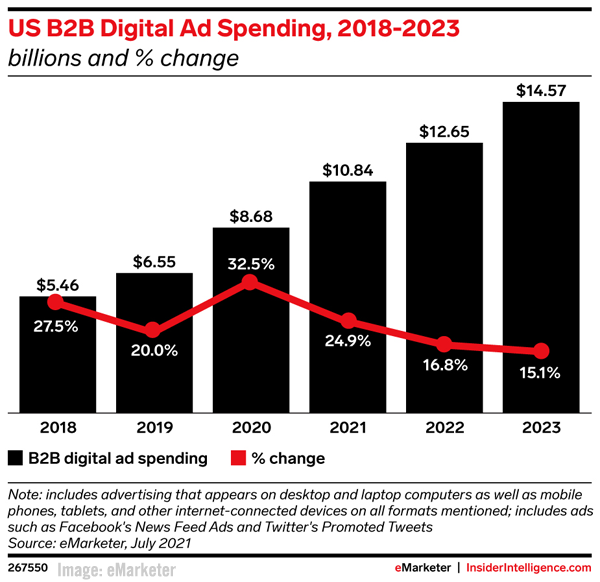
eMarketer’s B2B Advertising Forecast 2021: 6 Key Insights & Revelations
Technology and financial services top the list of industries when it comes to B2B advertising spending, with tech products and services accounting for some 32 percent and FinServ 25 percent — two of numerous statistics of interest to B2B marketers contained in recent advertising forecast data. LinkedIn (client)
ON THE LIGHTER SIDE:
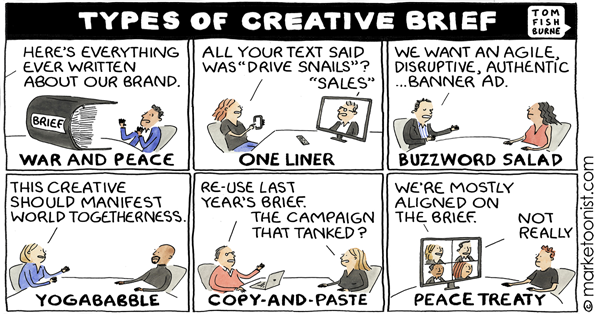
A lighthearted look at the “types of creative brief” by Marketoonist Tom Fishburne — Marketoonist
Q&A With Adobe’s Brian Glover: The New Era Of CX Initiatives — Demand Gen Report
TOPRANK MARKETING & CLIENTS IN THE NEWS:
- Lee Odden — Influencer Marketing for B2B [Podcast] — Digital Marketing Institute
- Lee Odden — The Top Content Marketers: 64 Influential & Educational Content Marketing Accounts You Should Be Following — Content Hacker
- Nick Nelson — 10 Tips for Finding Your Way as a New Entrepreneur — Small Business Trends
Have you found your own top B2B marketing news from the past week of industry news? Please drop us a line in the comments below.
Thanks for taking the time to join us for this week’s TopRank Marketing B2B marketing news, and we hope that you will return again next Friday for more of the week’s most relevant B2B and digital marketing industry news. In the meantime, you can follow us on our LinkedIn page, or at @toprank on Twitter for even more timely daily news.
The post B2B Marketing News: B2B Digital Ad Spending Grows, Google Adds Knowledge Graphs For Podcasts, Instagram’s New Creator Features, & Gen Z Engagement Study Insights appeared first on B2B Marketing Blog – TopRank®.
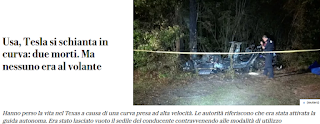
La bufala della Tesla schiantatasi in Texas e “nessuno era al volante”

Ricordate la vicenda della Tesla Model S che ad aprile 2021 si era schiantata vicino a Houston mentre “nessuno era al volante”, secondo la polizia e come scriveva Repubblica? Le due persone a bordo erano morte.
Ora la perizia tecnica del National Transportation Safety Board dimostra, sulla base dei dati recuperati dalla “scatola nera” di bordo, che c’era eccome una persona al posto di guida e che l’acceleratore era premuto praticamente a fondo (al 98,8%) e che la velocità massima registrata nei cinque secondi precedenti l’impatto è stata di 108 km/h.
Data from the module indicate that both the driver and the passenger seats were occupied, and that the seat belts were buckled when the EDR recorded the crash. The data also indicate that the driver was applying the accelerator in the time leading up to the crash; application of the accelerator pedal was found to be as high as 98.8 percent. The highest speed recorded by the EDR in the 5 seconds leading up to the crash was 67 mph.
L’Autopilot, insomma, avrà anche un nome discutibile, ma in questo caso proprio non c’entra nulla. Vediamo se i giornali che hanno pubblicato la notizia iniziale pubblicheranno la rettifica. Per ora l’articolo di Repubblica è ancora al suo posto, com’era sei mesi fa, senza alcuna menzione dei nuovi risultati della perizia. Ne salvo una copia permanente, non si sa mai che qualcuno scopra il ravvedimento operoso.
La mia indagine iniziale, con tutti i dettagli e la cronologia della vicenda, è qui.
Questo articolo vi arriva gratuitamente e senza pubblicità grazie alle donazioni dei lettori. Se vi è piaciuto, potete incoraggiarmi a scrivere ancora facendo una donazione anche voi, tramite Paypal (paypal.me/disinformatico) o altri metodi.

Podcast del Disinformatico RSI 2021/10/22: Virus replicanti, oggi e 20 anni fa. Da Iloveyou a FluBot
Il messaggio vocale, però, in realtà non esiste e il link porta invece a un avviso che dice che per ascoltare il messaggio la vittima deve installare un’app apposita non ufficiale che non si trova nei normali archivi di app. Questa app è il virus vero e proprio.
Se la vittima abbocca all’esca emotiva e la installa, FluBot prende il controllo dello smartphone e si mette in attesa. Quando la vittima usa il telefonino per una transazione bancaria, FluBot se ne accorge, ruba il nome utente e la password e intercetta l’SMS che contiene la password aggiuntiva temporanea necessaria per validare la transazione. Fatto questo, ha tutto il necessario per prendere il controllo del conto corrente della vittima e consegnarne il contenuto ai criminali informatici che gestiscono il virus.
Già che c’è, FluBot usa la rubrica telefonica della vittima per trovare nuovi bersagli, esattamente come faceva Iloveyou, e questo gli consente di propagarsi in modo esplosivo.
Rimuovere FluBot dal telefonino, inoltre, non è facile: non basta togliere l’app ma è necessario un riavvio in Safe Mode, una procedura che è meglio affidare a mani esperte.
C’è anche un altro parallelo con quell’attacco di due decenni fa: FluBot può colpire soltanto se l’utente clicca sul link presente nel messaggio, proprio come avveniva con lloveyou. Senza questo primo gesto, l’attacco fallisce.
FluBot e Iloveyou sono accomunati anche da un’altra peculiarità: funzionano soltanto su alcuni tipi specifici di dispositivi molto diffusi. Iloveyou poteva agire soltanto sui popolarissimi sistemi Windows 95 che usavano Outlook; non aveva alcun effetto sui computer MacOS o Linux. Allo stesso modo, oggi FluBot colpisce soltanto gli smartphone, e specificamente gli smartphone Android; non ha effetto sui telefonini non smart e sugli iPhone.
L’attacco di FluBot, quindi, ha effetto soltanto se si verifica una catena ben precisa di errori dell’utente:
- la vittima si fida del messaggio di invito, pensando che provenga da un suo conoscente fidato;
- clicca sul link presente nel messaggio;
- scarica e installa un’app non ufficiale senza chiedersi come mai non è presente negli App Store normali;
- e usa uno smartphone Android senza proteggerlo con un antivirus aggiornato.
Se manca uno solo di questi anelli della catena, l’attacco fallisce.
Oggi come allora, insomma, difendersi dagli attacchi informatici più diffusi è soprattutto questione di emozioni, di psicologia più che di tecnologia. E siccome la psicologia umana non cambia e non si aggiorna, certe trappole funzionano sempre e continueranno a funzionare.
La differenza è che adesso le trappole psicologiche vengono usate dal crimine organizzato, mentre vent’anni fa Onel de Guzman era semplicemente uno smanettone che voleva usare Internet a scrocco. E la sua esca psicologica era altrettanto semplice: il bisogno universale umano di sentirsi amati da qualcuno.
—
Informazioni su FluBot e istruzioni per riconoscerlo e rimuoverlo
Guida dell’operatore telefonico svizzero Salt (in italiano).
Descrizione tecnica dettagliata di FluBot (Switch.ch, in inglese).
Articolo di Le Temps.ch (in francese).
Avvertenza del Centro Nazionale per la Cibersicurezza svizzero (in italiano, giugno 2021).
Fonti aggiuntive: CNN, Sophos, AP Archive, Graham Cluley.