8 more things to love about the new Pixel phones
Last week we unveiled the new Pixel 6 and Pixel 6 Pro — and we unveiled a lot. Aside from the two new phones themselves, there was also Google Tensor, our custom system on a chip (SoC) that takes advantage of our machine learning research. Then there’s Magic Eraser, which will take unwanted people and objects out of your photos — plus Pixel Pass, a new way to buy, and a ton of new features packed into Android 12.
Pixel 6 and Pixel 6 Pro
The Pixel 6 and Pixel 6 Pro have arrived, and so have plenty of new features.
Amid all thenew, you may have missed a thing or two. But don’t worry, we went ahead and collected everything you might have missed, and some extras, too.
- One of the key differences between Pixel 6 and previous editions is the radical redesign of the hardware encasedin aluminum and glass.
2. Real Tone is a significant advancement, making the Pixel 6 camera more equitable, and that’s not all: It also improves Google Photos’ auto enhance feature on Android and iOS with better face detection, auto white balance and auto exposure, so that it works well across skin tones.
3. Speech recognition has been updated to take advantage of Google Tensor so you can do more with voice. We’ve added automatic punctuation while dictating and support for voice commands like “send” and “clear” to send a message or edit it. With new emoji support, I can just say ‘‘pasta emoji” while dictating. (Which, I admit, is going to get a lot of use.)
4. We’ve partnered with Snap to bring exclusive Snapchat features to the Pixel. For example, you can set it up so when you tap the back of your Pixel 6 or Pixel 6 Pro twice, it will launch the Snapchat selfie camera.
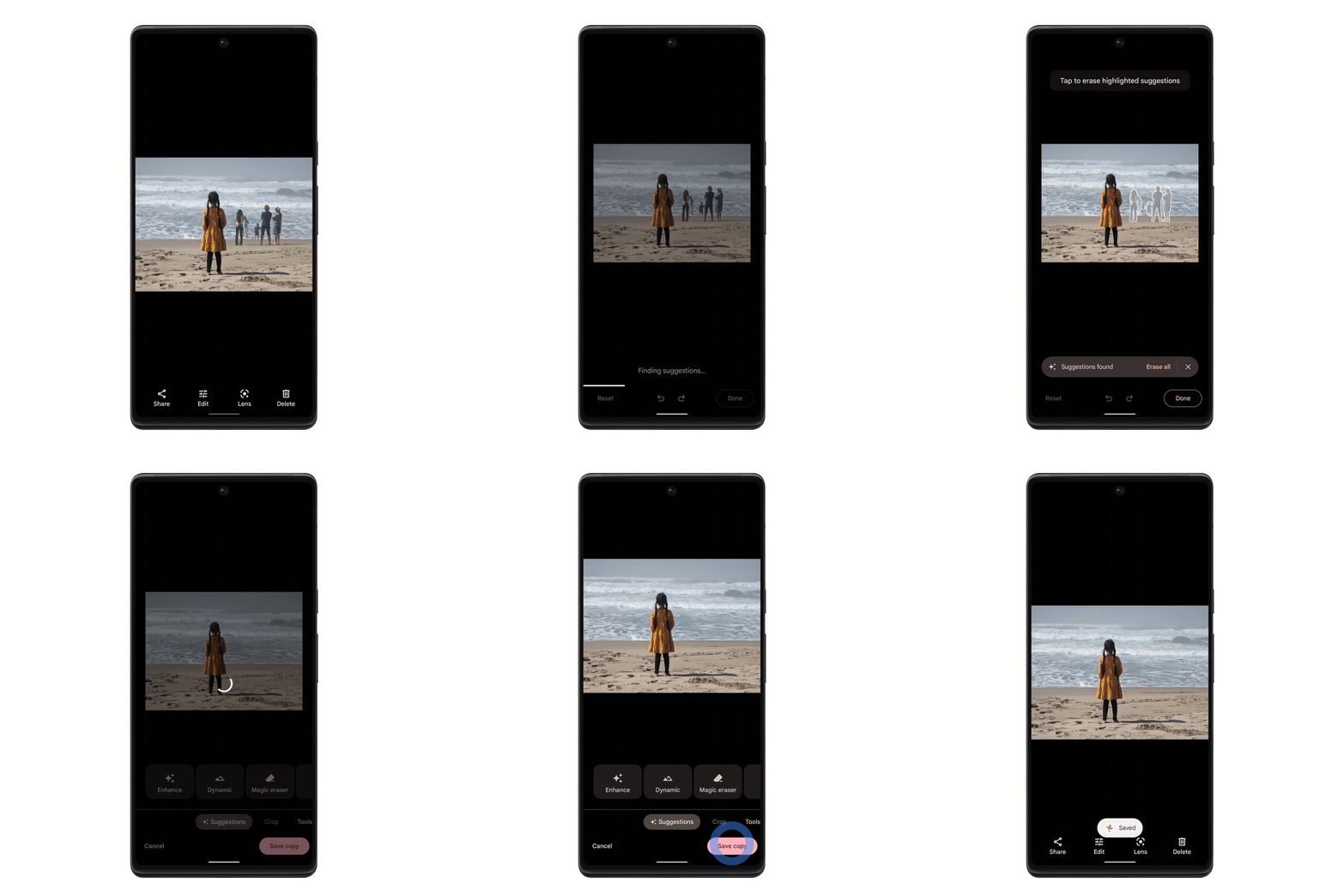
5. When you’re flipping through your photos on a Pixel 6 or Pixel 6 Pro, Google Photos can proactively suggest using Magic Eraser to remove photobombers in the background.

Our work to keep you safe online is never done
At Google, we keep more people safe online than anyone else with products that are secure by default, private by design and put you in control of your data. To celebrate Cybersecurity Awareness Month, we’ve introduced new features and technologies that keep your data private and secure.
Protecting your privacy with products that are secure by default
Protecting your privacy starts with the most advanced digital security. That’s why we make our products secure by default and help keep your data safe with customized recommendations in Security Checkup, an easy, personalized way to secure your Google Account. So whether you’re browsing the web, managing your inbox, or sharing your vacation photos, we’re keeping you safe with automatic protections built right into our products. Today we’re excited to share some new security products and features:
- Introducing the New Security Hub on Pixel: The Security Hub brings all your security-related features and settings into one place on your Pixel device. In the hub, you’ll see a clear red, yellow, or green indication of whether your system is secure based on inputs from Google Play Protect to your Google Account. If there’s something wrong, the Hub will give you straightforward recommendations of what’s wrong and what to do next. This feature is currently only available on Pixel devices, but we have plans to roll this out to our entire ecosystem in the future.
- Google Fi Announces End-to-End Encrypted Calls: On top of built-in VPN and spam blocking features included in all phone plans, Google Fi is introducing end-to-end encrypted calls. One-to-one calls between Android phones on Fi will be secured with end-to-end encryption by default when they become available in the coming weeks, so your phone conversations stay between you and the person you’re talking to.
- Google One Announces VPN Expansion to New Countries: VPN by Google One keeps your network activity safer from hackers and online eavesdroppers. Already available on Android for Google One members on Premium plans (2 TB and higher) in Canada, France, Germany, Italy, Mexico, Spain, the United Kingdom, and the United States, starting today, we’ll begin rolling out the VPN in 10 more countries: Austria, Belgium, Denmark, Finland, Iceland, Ireland, the Netherlands, Norway, Sweden and Switzerland.
- New Safe Browsing in Android Messages & Chat: Enables stronger protections against phishing and malware attacks, checks uncommon URLs in real-time to assess threats, and temporarily links data to your Google Account to offer tailored protection.
- Chrome HTTPS-First Mode: HTTPS is a secure and private way for users to communicate with websites, reducing the risk of threats like network eavesdropping. With HTTPS-First Mode activated, Chrome will upgrade its connection to all pages a user visits to HTTPS. If HTTPS isn’t supported, the user will be shown a warning before loading a site with a less secure connection.
Building products that are Private by Design
Protecting user privacy is core to how we conceptualize, design, and build our products. This means continuously making thoughtful decisions about when, how, and why data is used in our products – and minimizing data use and retention when possible.
That’s why we’ve worked to create and open source privacy preserving technologies like Differential Privacy and Federated Learning. These technologies allow us to give you a customized experience without identifying individuals and while minimizing the amount of data that’s collected.
Ephemeral Learning is another privacy preserving technology that we’ve used to help train the models that power some of our most helpful features. Ephemeral Learning is a privacy-preserving technique that applies to cases where the training model runs on Google’s servers. Incoming data samples are stored in short-term memory for a training algorithm to learn from, and then they’re deleted within minutes. These samples are processed without any additional user signals, and without humans ever looking at the data. This technique allows us to train the models that power features like voice-to-text transcription while preserving privacy and reducing the amount of data stored.
We’ve also recently developed and open sourced Private Set Membership – a privacy preserving technology that makes it possible for an individual device to check membership against a dataset while maintaining the privacy of both the device and the dataset. This builds on our previous work on Private Join and Compute. As always, we’re committed to open sourcing and making these technologies widely available for developers around the world.
You’re in Control with Powerful Privacy and Security Settings
You should be able to choose the privacy settings that are right for you, with controls that are easy to use and understand and available right in the product when you need them. That’s why we created one place to manage settings in your Google Account, introduced Auto-Delete options, and created controls that appear in context when you’re using our products.
Back in May, our Photos team introduced Locked Folder on Pixel – a passcode-protected space where you can save photos and videos separately, so they won’t show up as you scroll through Google Photos or any other apps on your device. We’re excited to share that this feature is coming to Google Photos on Android soon, and to iOS early next year.

Photoshop e Illustrator arrivano direttamente su browser
Are we stronger than we give ourselves credit for?
Fitbit is working with Professor Ilona Boniwell as part of paid collaboration to develop insights and guidance on positive psychology. This blog is based on that information as well as the results of a survey conducted by an independent third party, Course5 Intelligence, of general consumers in 12 countries across Europe, Middle East and Africa.
What do you think of when you hear the word strong? An image of a weightlifter, Olympian or someone that can withstand a lot of exertion? Strong, based on its traditional dictionary definition, is a word that evokes images of physical fitness and being ‘tough.’ However, perceptions of the word are shifting as more people prioritize inner strength and self care. Here at Fitbit, we think the last 19 months in particular has shown how a holistic approach to health, prioritizing both our mental and physical well-being, can help us feel strong in uncertain times.
In a recent survey conducted by Course5 Intelligence on behalf of Fitbit in August 2021 of more than 13,000 people in France, Germany, Ireland, Italy, Netherlands, Norway, Poland, South Africa, Spain, Sweden, UAE and the UK1, one in ten people surveyed believe the traditional, or dictionary definition, concept of ‘strength’ as being physically strong. 46% of those surveyed recognize that the definition of true strength is a combination of mental and physical traits while 39% of respondents define it as the ability to deal with the stresses and challenges that life can present us with. So how can we lean into our inner strength to enhance our lives? Strength looks different for everyone and most of the time we can easily define someone else who we perceive as strong — but don’t necessarily think of ourselves as strong based on our own personal definition of it.
This tendency to overlook our own strengths is reflected in our survey whereby 68% of respondents cited someone other than themselves when asked to name the strongest person they know, and instead naming a parent (20%), friend (10%) or spouse (10%). Though it’s great to recognize other people in our lives as strong individuals, honing in on our own strength and flexing it can help shift one’s mindset.
What makes you feel strong?
Positive Psychologist, Professor. Ilona Boniwell who teaches positive leadership at l’Ecole Centrale Paris and HEC Business School, states: “If something doesn’t feel right people automatically look for what is wrong, what am I not doing right. I encourage people to think differently. Instead, look at what is working for you — when do you feel stronger? – and focus on that to affect any changes you want to make. A shift in mindset and strengthening your self-belief will help build resilience that will help you better cope with daily stressors and challenges — which is something we all face.”
When it comes to how people build mental strength to feel ready to take on each day, sleep comes out on top with 66% of people surveyed saying a good night’s rest helps them feel strong. Physical exercise came second for 52% of those surveyed, while the mindful activity of setting goals came third with 32% of people.
Tools to improve mental well-being
“The idea of ‘self-care’ is much more than a buzzword, it is a continuous practice and, like strength, it doesn’t mean the same thing to everyone. Mental strength is increasingly recognized as a major part of our overall health, but it takes time to nurture. Fitbit can help support your self-care practices with over 300 sleep and meditation relaxation session in Fitbit Premium2, including content from Calm, the #1 App for Sleep and Meditation3 and Deepak Chopra, M.D., Pioneer of Integrative Medicine, and Founder of The Chopra Foundation and Chopra Global, whose exclusive Mindful Method sessions are designed to help improve your emotional well-being,” Joanne Savage, Marketing Director in EMEA, Fitbit at Google.
So, more people are checking in with themselves, but what about how we speak to ourselves? Much of self-talk depends on your personality. In the survey, the findings show that men are more likely to engage in a more positive internal dialogue (42%) or what’s known as ‘positive self-talk’ compared to 33% of women. Alongside gender discrepancies, there were also differences in generations as well. According to the findings, when it comes to discussing mental resilience, 71% of those aged 25-44 were more likely to feel comfortable talking about their mental and physical strength with friends, family members or colleagues, as opposed to 67% of those aged 18 – 25.
“This is a strength in itself, recognizing how important it is to talk, to share how we are feeling with others,” said Professor Boniwell. “If you take time to focus on the positive aspects of your daily experiences you will begin to recognize just how strong you are. Before going to bed every night, think back over your day and remember three good things that happened – things that went well, that you succeeded in, enjoyed or were grateful for. This is more important than you think — appreciation helps you realize what you have accomplished, which, in turn, fuels your self-belief.”
As people move towards a more holistic approach to health, our recent survey shows that sleep and exercise are a top priority in feeling mentally stronger. To build on this, Professor Boniwell’s advice in shifting our mindset can help build resilience and therefore our coping skills with the inevitable daily challenges that arise. Fitbit can support your goals to help feel stronger through the community and tools which can help with your sleep, mindfulness and activity. Visit www.fitbit.com for more inspiration.
Professor Boniwell is one of the European leaders in Positive Psychology, having founded and led the first Masters Degree in Applied Positive Psychology at the University of East London. Today, she leads the International MSc in Applied Positive Psychology (I-MAPP) at Anglia Ruskin University and teaches Positive Management at l’Ecole Centrale Paris and HEC Business School, and consults around the world as a director of Positran. Her main teaching expertise lies in the areas of Positive Psychology and Positive Psychology applications.
1 A survey by Course5 Intelligence conducted on behalf of Fitbit in August 2021 of 13,053 adults in 12 countries across Europe, Middle East and Africa. (UK, Ireland, France, Germany, Italy, Spain, Netherlands, Norway, Sweden, Poland, South Africa, and UAE). The participants are a representative sample as selected by Course5 Intelligence.
2 Fitbit Premium is only available in select languages. Content & features subject to change. Access these services in the Fitbit app. Fitbit app is only available for compatible Android and iOS devices. Internet connection required for use.
3 Calmcontent is only available in English, Spanish, Portuguese, French, German, Japanese, and Korean.

How 15 years in IT brought Subhasish to Google Maps
Welcome to the latest edition of “My Path to Google,” where we talk to Googlers, interns and alumni about how they got to Google, what their roles are like and even some tips on how to prepare for interviews.
Today’s story is all about Subhasish Roy from our Hyderabad office. Subhasish shares how he brings the lessons he’s learned from over 15 years in IT to his current role as a Program Manager on the Google Maps team.
What’s your current role at Google?
I am a Program Manager on the Google Maps data moderation team, where I lead multiple projects to review the helpful content our users submit to Google Maps — like whether a business is still open, and if their hours, business name and other information are still accurate. What I love most about my role is working with a diverse team that is passionate about giving users the best experience possible.
Describe your typical workday.
I’m working from home like many others around the world. I generally start by planning and prioritizing my day with to-do lists and action items. Then, I usually have several video meetings with teams based in six offices across four time zones, including India, Ireland and the United States. Googlers are always collaborating using Google Docs, so I spend a good amount of my days working with my colleagues on strategy documents or reviewing proposals.
What made you decide to apply to Google?
I dreamed of working at Google ever since I learned more about the internet and its potential to impact millions of lives. Google continuously innovates to make people’s lives easier, which inspired me to think big and want to work here.
How did you get to your current role?
I’ve had many roles during my 15+ year IT career. I started out as a software engineer and, from there, took on different positions — including team lead, project manager, development manager, and technical program manager. Along the way, I developed many skills, like managing teams, communicating and negotiating with customers, and eventually leading a large-scale enterprise application development team across multiple time zones and languages.
Despite all of this experience, I was still anxious about applying to Google because I didn’t study at one of the top-tier universities in India. I also wasn’t sure if I would be a good match for the culture or how my experience would fit into Google, since I hadn’t coded for 10 years at that point. However, once I got to Google, I was able to channel all of my experience and the skills I’ve developed throughout my career into leading teams, experimenting, and building products. I have access to world-class technology and talent, and the impact of my work has reached new heights.
What inspires you to log on every day?
More than a billion users every month use Google Maps for their daily commutes. I am inspired knowing that the work I’m doing is helping people. It’s also a great feeling to work with so many smart people. It provides incredible learning and growth opportunities, and drives my daily energy.
Can you share any of the resources you used to prepare for the interview?
I used sites like LinkedIn Learning, online videos and training classes, and sessions from the Life at Google YouTube channel.
Do you have any advice you’d like to share with aspiring Googlers?
Show your willingness to think outside of the box. It sounds cliché, I know, but the way you think can take you far. That expertise that you might think doesn’t apply to the role you want at Google may be exactly what gets you the job!
Media literacy training for Southeast Asian communities
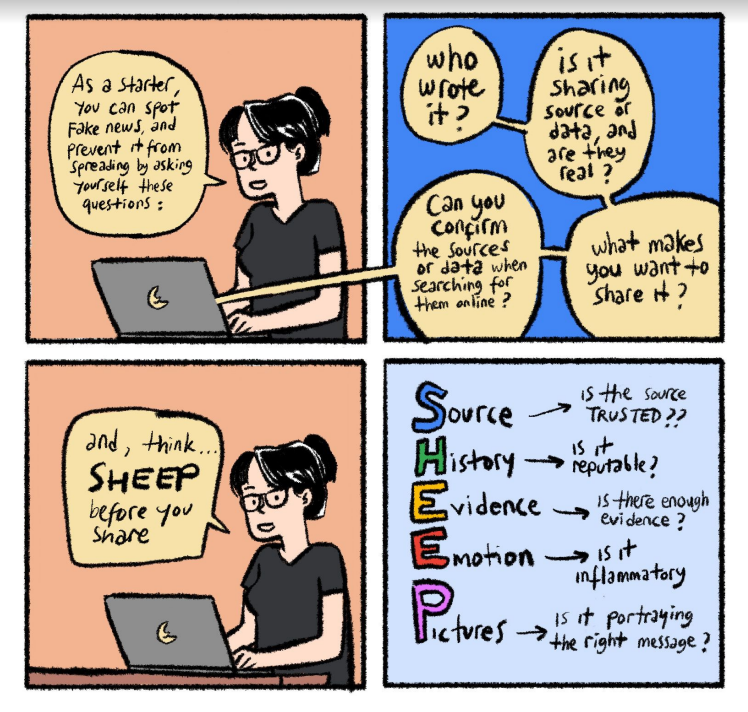
Forty million people in Southeast Asia started using the internet for the first time in 2020. Yet the level of media literacy in the region remains relatively low. Often, people in Southeast Asia lack the skills to interpret the information they encounter online — and efforts to change this have historically been fragmented and under-resourced.
As we mark 10 years since UNESCO’s first Global Media and Information Literacy Week, we want to ensure more Southeast Asians — especially first-time users — can navigate the internet with confidence. Today, we announced a $1.5 million grant from Google.org to help the ASEAN Foundation expand media literacy education in the 10 countries that make up the Association of Southeast Asian Nations. The goal is to equip more than 1,000 trainers with new skills and materials, enabling them to provide training for more than 100,000 people — from young people to older internet users — over the next two years.
In addition to the Google.org grant, Google employees plan to volunteer their time and technical expertise to the ASEAN Foundation and its beneficiaries.
We know strengthening media literacy has to be a collective effort, and at today’s ASEAN Digital Literacy Forum — the first event of its kind in the region — we joined 200 representatives from governments, academia, and nonprofit organizations to discuss the most effective ways to address online misinformation.
We’re doing a lot with technology itself, from raising up authoritative websites in Google Search to creating better tools for fact-checkers. But the most sustainable way forward involves the public, private and nonprofit sectors working together to give people the knowledge they need.

Stay safe online ahead of shopping season
Do you hear that? Click, tap, kaching! The frenzy of the year-end shopping season is upon us. In Asia, that means big shopping occasions like 10/10, 11/11 and 12/12. It also — unfortunately — means an increase in risks that users face, as more people head online and the range of threats from cybercrime increases.
According to data from the United Nations, cybercrime has already risen 600% since the start of the COVID-19 pandemic. But how and why are people still at risk? Where are people most vulnerable? And what can we do differently to better protect ourselves online, not just during shopping season, but all year round? To find out, we commissioned a study, conducted by YouGov, surveying over 13,000 respondents aged 18 and above across Asia-Pacific. Here are our findings, and our top tips for staying safe online.
1. Password recycling = risk
Poor password “hygiene” is far too common in Asia-Pacific, with over 80% of respondents using the same passwords across multiple sites, and almost half admitting to recycling passwords for up to 10 unique sites. If a password is stolen on any of these sites, a user’s accounts on the other sites become vulnerable as well. A worrying 1 in 2 respondents also confessed to using guessable passwords with easily-crackable combinations, such as significant dates and names of partners or pets.
What do we suggest people do instead?
- Create a unique password for each account to eliminate this risk. Make sure that each password is hard to guess and better yet, at least eight characters long.
- Use a password manager to make it easier to create and use strong and unique passwords on all your devices, without the need to remember or repeat each one. Google’s Password Manager, built directly into Chrome, Android and the Google App, can help you do this. Using a password manager makes signing in convenient, especially on small mobile screens – instead of entering in a password each time, you can just press a button
2. Set up your security safety net
According to our study, two in three respondents across Asia-Pacific have experienced a data breach or know someone who has. Here are some ways you can protect yourselves against fraud.
- Set up a security phone number or email address, and keep it updated so banks and other service providers can contact you right away if there’s suspicious activity on your account.
- Take the Google Security Checkup to preemptively strengthen the security of your Gmail account and get personalized security recommendations — it only takes two minutes to complete. Since people often use their Gmail accounts to register with their banks, shopping sites, and payment services, this increases security on top of our automatic protections.
- Set up 2-Step Verification(2SV) on every site that offers it. This dramatically increases security by requiring “something you know” (like a password) and “something you have” (like your phone or a security key).
More than 60% of people we surveyed said they are likely to adopt 2SV, but only 6% of people we surveyed currently use it. We know the best way to keep people safe is to turn on Google security protections by default. By the end of 2021, we plan to auto-enroll an additional 150 million Google users in 2SV and require two million YouTube creators to turn it on.
3. “Add to Cart” with Care
Three in four people admit to making purchases on pages without the secure symbol, increasing the opportunity for fraudsters to steal details.
We recentlyannounced HTTPS-first mode in Chrome. HTTPS is a secure and private way for people to communicate with websites. If you enable this mode, Chrome will show you a warning if a website doesn’t support HTTPS.
We also recommend making sure you’re always running the latest version of software on all your devices. Some software, like Chrome, will automatically update. For other services that send notifications when it’s time to update, don’t click “remind me later”— take the time to install the update right away.
As you get your shopping lists ready, we encourage you to find more online security tips by visiting Google’s Safety Center. You can also explore this virtual exhibition to learn more about Google’s approach to security and privacy. Happy shopping!
Protecting your Google Fi calls with end-to-end encryption
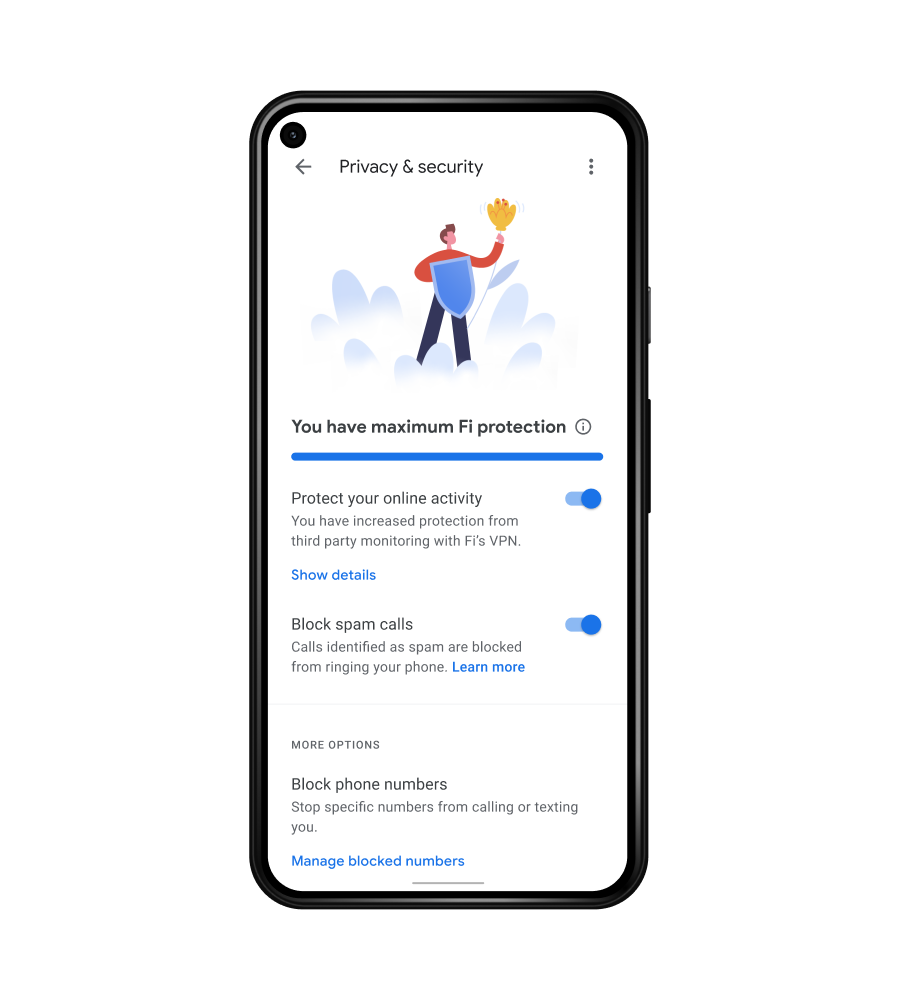
What you share with friends, family and others on phone calls is your business. Google Fi has always been committed to keeping your personal information safe, and we want to help you keep your personal conversations private, too. That’s why today, we’re announcing end-to-end encrypted calls, starting with Android phones on Fi.
What is end-to-end encryption?
End-to-end encryption is a complex term for a simple idea: that no one besides you and the person you’re talking to should be able to hear what you’re saying over the phone. End-to-end encryption has become an industry standard for real-time communications such as messaging — and now, we’re bringing it to phone calls, right from your Phone app. Calls between two Android phones on Fi will be secured with end-to-end encryption by default, so you can have peace of mind knowing your calls are staying between you and the person you’re talking to.
End-to-end encryption is the latest addition to the collection of privacy and security features that come included at no extra charge in all Fi plans, alongside our built-in VPN for a private online connection and spam blocking to stop unwanted calls.

Widgets just got better on Android 12
Last week, we announced new widgets for Android to bring helpful content and actions from your Google apps right to your Home screen. And today, they’re officially live. Here’s a rundown of what’s now available, and what we’re most excited about.
Personalization with Material You
Your device should be just as unique as you are, so we’ve redesigned our widgets to bring the best of Material You to your Android phone.
All widgets can be resized so you can fit different combinations on your phone screen based on what’s important to you. As you resize, your widgets will change. If you make your widgets bigger, you’ll get more functionality (more space means we can squeeze in more useful features).
And on select Android 12 devices — including the Pixel 3 or later — widgets will dynamically change color as you move each one around your chosen wallpaper.
Resize each widget to best suit you.
Easy directions with Maps
If you’re on the go, the new Google Maps widget makes it easy to find what you’re looking for and puts helpful actions within reach. For example, if you’re looking for the nearest coffee shop or gas station, you can quickly search for them with just one tap from the widget.

The Google Maps widget, with quick, tappable search suggestions.
Help with your to-do list
Google Keep widgets can help you manage that seemingly endless to-do list. Choose from two widgets designed to put your favorite Keep functionality on your Home screen, like a tappable to-do list that’s front and center on your Android device.
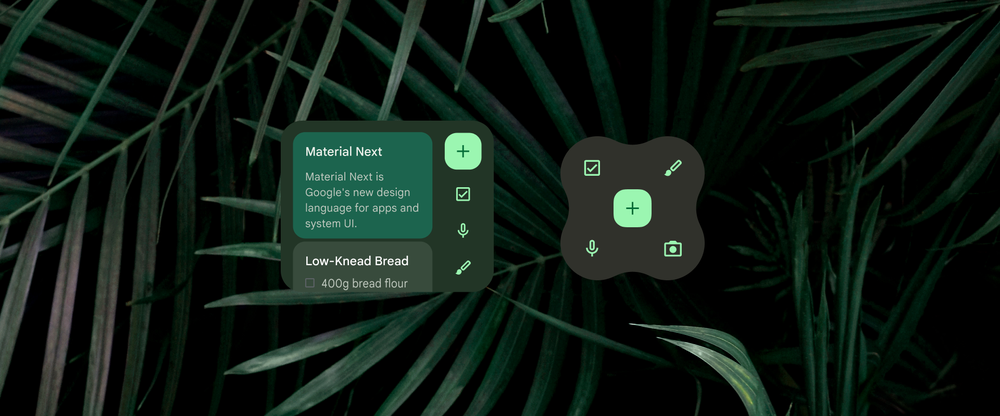
The Google Keep widgets offer quick actions and a dynamic to-do list.
Frames for your favorite Memories
The Google Photos Memories widget will be the first to use the new freeform widget frames in Material You, showing off your photos in fun and interesting shapes across your Android device.

Google Photos uses the unique Material You widget shapes.
Quick access to your files and photos
The Google Drive widget makes it easier to upload and search for files. And if you choose the larger widget, you can open suggested documents with just one tap.
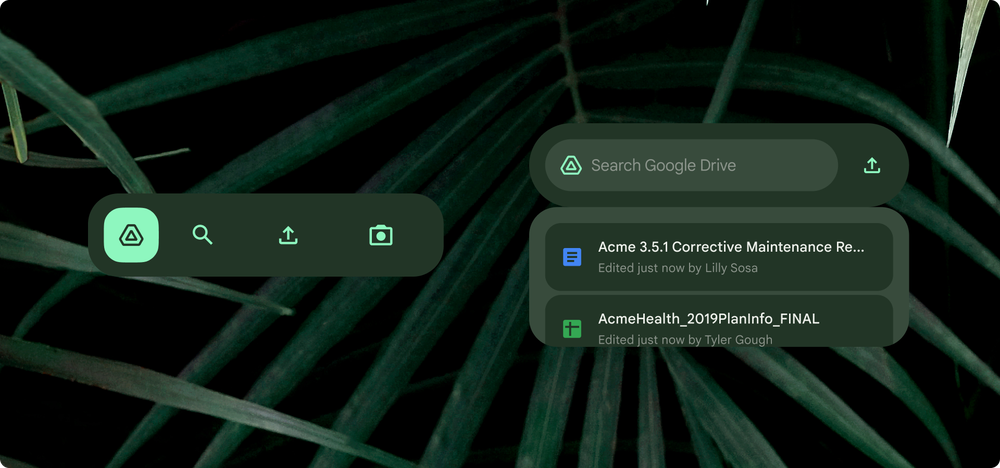
Google Drive widgets give you quick access to your files and photos.
Non-stop listening
If you listen to tunes on YouTube Music, you can place tappable playback controls anywhere on your Home screen with the new widget. Plus, you can see what’s playing without opening the app.

YouTube Music widgets put playback controls on your Home screen.
Simple view of your data usage
For Google Fi phone plan customers, an updated widget will help you easily manage your monthly data usage. And just like the previous widget, the new one will alert you when you’ve used a specific amount of data, and allow you to set data limits for other plan members from the Fi app.

Track your data usage with the Google Fi widget.
Closer eye on the time
With new clock widgets, you can choose from four analog clock faces for your Home screen. Each clock face is a creative design with a ticking second hand. And if you need it, a new digital stopwatch widget will help keep you on track (and on time).
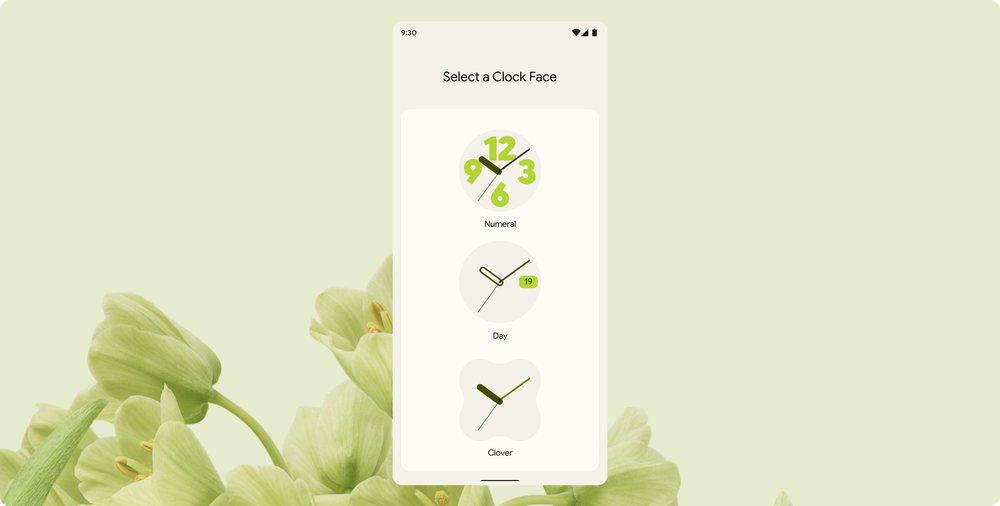
The analog clock widgets have ticking second hands.
Most of all, we’re excited to see how you’ll combine these new widgets to create a more helpful, personalized Android device that’s as unique as you are.

A Googler tells us how the world can show up for Afghans
In the early 1980s, Shahla Naimi’s mother arrived at a United States air force base in California as a refugee from Afghanistan. Weary from her journey, she was met by a group of volunteers who welcomed her to her new home. So began her new life in the United States.
40 years later, Shahla – a Senior Program Manager at Google – found herself at a government facility in New Jersey where she partnered with the International Rescue Committee to welcome 9,000 Afghans who’d fled the recent Taliban takeover in Afghanistan.
“I didn’t realize how many times my heart could break,” says Shahla. “It was the most emotionally and physically exhausting experience I’ve ever had – and perhaps the most rewarding one as well. As an Afghan and as an American, it pushed me in unexpected ways to see my own people so newly displaced from their homes.”
We recently took some time to ask Shahla about her work with the IRC.
What are your ties with Afghanistan?
I am Afghan! I grew up in south L.A. in the wake of 9/11, fairly isolated from the broader Afghan-American community but surrounded by fellow immigrants from all over the world.
I traveled to Afghanistan for the first time in 2011, when my uncle encouraged me to visit him in Kabul. Walking around the city, I saw my parent’s faces everywhere I went. Similar features, same classic Afghan expressions. Afghans from the diaspora occupy a complicated space in Afghanistan, and I was grateful to feel so welcomed.

Hisense: arrivano il Mini LED U9 e il nuovo OLED A8

Wiko Italia dà luce ad un nuovo progetto digital: Let’s Guru Up

Rubate delle chiavi per creare falsi Green Pass: allarme in UE

Call of Duty: Vanguard, gli zombi invadono Londra

Pixel 6’s camera combines hardware, software and ML
Last week, we announced Pixel 6 and Pixel 6 Pro, and we spent some time introducing the new Pixel Camera, which gets a big boost from Google Tensor, Google’s first System on a Chip (SoC) designed specifically for Pixel. But there’s so much more to talk about — so we wanted to take some time to show you how the new camera uses the latest technology from the Pixel hardware and research teams as well as our Pixel software team.
From HDR+ to Night Sight, Pixel has a history of building state-of-the-art cameras using computational photography, and Pixel 6 and Pixel 6 Pro are no exception. Google Tensor allows us to combine new camera hardware with thoughtful software, as well as advancements in machine learning (ML).