A year ago, weintroduced the new Google Analytics to help you meet the challenges of an evolving measurement landscape and get better ROI from your marketing for the long term. Google Analytics 4 properties offer privacy-safe solutions to measure the customer journey, machine learning to predict outcomes and automate the discovery of insights, and easy activation of those insights in Google’s advertising platforms to enhance your marketing performance.
Since then, we’ve introduced features like improved advertising reporting and support for user consent choices that help you achieve your marketing objectives without compromising user privacy.
Now, we’re launching additional capabilities, including an improved Search integration and smarter attribution to give you the insights you need to optimize performance across all of your marketing channels. We’re also introducing new modeling features that will close gaps in your data and help you future-proof your measurement.
With these additional capabilities, we encourage you to use the new Google Analytics as your primary web and app analytics solution going forward.
Easily access Search insights
Search Console provides detailed information about your website’s organic Search performance, including the site’s rank in Search results, queries that led to clicks, and post-click data like engaged sessions and conversions. With the new Search Console integration, you’ll be able to understand the role that organic Search plays in driving traffic to and engagement on your site relative to other marketing channels like Search ads, email, or social.
Get more value with data-driven attribution
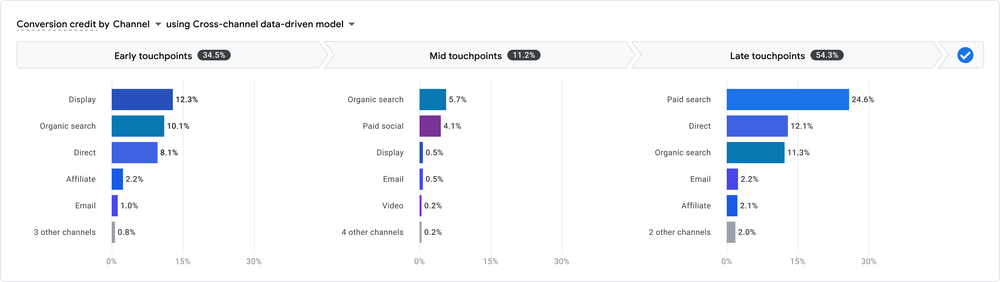
Building on the two attribution reports, Conversion paths and Model comparison, we announced earlier this year, we are introducing data-driven attribution – without minimum threshold requirements – to Google Analytics 4 properties.
Google’s data-driven attribution models give you a better understanding of how all of your marketing activities collectively influence your conversions, so you don’t over or undervalue a single channel. Unlike last-click attribution, where 100% of the credit goes to the final interaction, data-driven attribution distributes credit to each marketing touchpoint based on how much impact the touchpoint had on driving a conversion.