
Find the right Certified Publishing Partner for your monetization needs
Building a sustainable business from a website or app can take time away from the work publishers love the most, creating great content to connect with their audiences. Our Google Certified Publishing Partners are here to help you earn more, find opportunities, and grow your audience.
To help you select the right partner for your needs, we recently relaunched the Find a Partner page on the Google Certified Publishing Partner website. The new page includes a more detailed list of services that partners offer and more detailed full-page profiles of each company. You can learn more about what a partner specializes in, read publisher success stories and find other useful information to make the right decision.
How Certified Partners can help
Our Certified Partners are experts on Google monetization products and provide innovative solutions and services to support over 50,000 publishers worldwide across all sizes and verticals including news, lifestyle, fashion, gaming and food, among other content categories. Our partners are highly trained and aware of the different challenges that publishers in different verticals face.
Monetization services
The core solutions that our partners provide are around helping publishers monetize their site or app content to reach their highest potential, using Google Ad Manager, AdMob, or AdSense along with custom products and solutions. This includes ad set-up, trafficking and optimization, programmatic solutions and technical support on a day-to-day basis.
Many partners also provide focused monetization support in areas like video, mobile apps and custom ad formats. Our partners are here to support you in every step of the monetization process, regardless of your expertise or experience.
Complementary services
Beyond monetization, Certified Partners also offer a wide range of additional services to help you grow your business. This includes user acquisition services, content management, page speed optimization, mobile app and website analytics and more.
You can find the full list of services and definitions here. Certified Publishing Partners may offer additional products and services on their own websites.
Look for the badge
To become certified, service providers are carefully reviewed by Google and must demonstrate product expertise through annual product exams. The official badge also shows that the partner has met quality requirements to ensure their performance and value in the online and apps publishing ecosystem.
Organize your documents effortlessly with Stack
Have you ever lost a receipt you needed for a refund? Or misplaced an important tax document? Or forgot a bill and incurred a fine? I’ve done all three. (More than once!)
As we go through life, we come across many documents that we might need in the future. Organizing these documents takes time and effort. So, if you’re anything like me, you might end up with piles of papers lying around your house (or PDFs scattered across your computer desktop). And good luck finding them when you actually need them.
I joined Google a couple of years ago when my education startup, Socratic, was acquired. At Socratic, we used Google’s computer vision and language understanding to make learning easier for high school students. I wondered if we could apply the same technologies to make organizing documents easier.
To experiment with this idea, my colleague Mathew Cowan and I joined Area 120, Google’s in-house incubator. We worked with DocAI, a team in Google Cloud whose artificial intelligence has helped companies analyze billions of documents. We found that by applying DocAI’s enterprise technology to personal documents, we could help people get organized.

Creating B2B Podcasts That Rise Above The Noise
It’s never impressive to hear someone say they have a podcast. Making a podcast is easy! I have one that’s nearly a decade old and 400 episodes strong.
The hard part is getting people to listen. My personal podcast has maybe 200 monthly listeners and brings in just enough in donations to pay for our web host. And at that, we have 198 more listeners than a lot of podcasts out there.
The barrier to entry is low… but if you’re a B2B brand looking to engage with potential buyers, you’re going to want to aim higher.
How do you make a B2B podcast that actually gets listened to? One that inspires people to subscribe and tell their friends about it?
It’s simple:
1) Use everything you know about content marketing to create and promote it, and
2) Make sure it’s polished, professional, unique and engaging
So simple!
Here’s how to make a B2B podcast that rises above the noise.
B2B Podcasting Tips for Creation, Promotion and Beyond
It’s tempting to jump into podcasting the easy way: Interview some employees and executives, record to an MP3, and post away. But creating a successful business podcast requires more strategy and production than your average hobbyist would do.
#1: Create a Content Strategy
You wouldn’t write a single blog post without doing research and strategizing (right? Don’t tell me if you would). And that’s to say nothing of an entire series of blog posts that takes hours of time to write and edit. Finding the right subject matter and understanding your audience are fundamental, foundational layers for content marketing.
The same due diligence that marketers do for content should apply to podcasting. Before you record a single word, you should know:
- Who your audience is. How can you personalize your content to appeal to the job title, experience level, vertical and personal experience of that audience?
- What your audience wants to know. Use tools like SEMrush, Answer the Public, and BuzzSumo to see what people are searching for and what terms they’re using to search for it.
- What burning questions you can answer. Your sales and customer service teams can be key for this one. Find out where deals are getting stuck for sales, and what frequently asked questions your customer service folks are encountering.
At the end of all that research, you should have a good idea of the topics to put in your podcast editorial calendar. As a bonus, when you create content around your podcast (more on that later), it will have all these keywords and topic clusters already built in.
#2: Plan for Promotion
Promoting a new podcast can be a substantial challenge. There are thousands of podcasts out there, and very little in the way of standardized search or SEO opportunities within the major podcast directories. You can start by making sure your podcast is listed on Google Podcasts, to show up in regular searches, but a lot of podcast promotion happens outside of the podcast itself.
Cross-promotion is one way for your podcast to find listeners. Reach out to other podcasts in a similar niche and offer to swap guest spots to promote each other. Remember, podcasting is not a zero sum game; people who listen to one podcast are more likely, not less, to listen to more.
Creating content around your podcast can boost visibility, too. Make each episode into a blog post with key takeaways and a full transcript. And, of course, include the podcast links in your social media and newsletter posts.
Paid advertising is an essential component, too. You can advertise on podcasts with a similar audience, sponsor social media posts, and even experiment with paid search.
Finally, don’t forget to market the podcast to your employees, too. Podcast directories use early listenership as a signal to make your podcast more visible. If you’re at an enterprise with thousands of employees, it should be easy to get enough critical mass to earn that extra boost.
[bctt tweet=”“Remember, podcasting is not a zero sum game; people who listen to one podcast are more likely, not less, to listen to more.” — Joshua Nite @NiteWrites” username=”toprank”]#3: Make It Professional
Plenty of podcasts — including some extremely popular ones — are completely DIY. The exquisite Welcome to Nightvale, for example, started with one $80 microphone and free recording software. But for B2B, you’re not competing against those passion projects — your audience is likely used to professionally-packaged programs like All Things Considered and Radiolab.
To make sure your podcast sounds professional, start with a modest investment in recording equipment. You don’t need a $1,500 microphone to record a podcast, but you do need something better than the built-in mic on a laptop. A couple of good-quality microphones and a simple mixing board should get you going for less than $500.
If you plan to do remote interviews of guests, a tool like Zencastr can help you capture high-quality audio that’s not dependent on the speed of your internet connection.
Instead of high-end audio equipment, save your budget for outsourcing post-production. Let a professional edit out the umms and ahhs, mitigate background noise, and properly level your audio.
#4: Keep It Interesting
Now let’s talk about the final touches that make a podcast engaging for your audience. This is where a little extra effort can really elevate the final product.
First and foremost: EDIT. Editing is a gift that you give to your audience. It’s easy to have a 2-hour conversation with an influencer or executive, mix it down and upload it. But how much more powerful would a 20-30 minute highlight reel be? Judicious, merciless editing is a key component of a polished podcast.
[bctt tweet=”“It’s easy to have a 2-hour conversation, mix it down and upload it. But how much more powerful would a 20-30 minute highlight reel be? Judicious, merciless editing is a key component of a polished podcast.” — Joshua Nite @NiteWrites” username=”toprank”]Even better, go beyond the simple interview format and think about a more topic-driven style. Rather than a single Q&A with one guest, capture audio from a few different experts on a topic (influencers, employees, customers) and weave them together with the help of an engaging host — more on that in a second. Listen to how it works in this episode of the SAP Tech Unknown podcast*:
Did you notice the sound effects and music cues in that episode? If not, it’s worth a listen — you’ll hear everything from squawking seagulls to tractors and roosters. All of those sounds were created in post-production — but they all serve to bring the listener further into the narrative.
Another key ingredient that you’ll hear in the podcast above is finding a charismatic, professional-sounding host. The right host can liven up potentially dull material, put your guests at ease, and steer conversations to interesting new places. Now, I’m not saying you need to hire a voiceover artist to be the host — in fact, you’re better off with an industry expert or someone in your organization. But make sure they have the gift of gab (Shoutout to the inimitable Tamara McCleary).
Please Cast Responsibly
The barrier for entry to podcasting is low — but the barrier to creating a B2B podcast that people will listen to is a little higher. The first step is to make sure your podcast will have relevant, interesting, unique content for your audience. Then it’s important to strategize your creation and promotion plan to help your podcast find an audience. Finally, it’s taking the steps to make sure your podcast is edited and produced to be a lean, no-filler, immersive experience.
Need help creating a memorable B2B podcast? Let’s talk.
*SAP Is a TopRank Marketing client
The post Creating B2B Podcasts That Rise Above The Noise appeared first on B2B Marketing Blog – TopRank®.

Ridefiniamo ciò che una mappa può fare grazie a nuove informazioni e all’Intelligenza Artificiale
Orientarsi negli ambienti interni grazie a Live View
Pianificate in anticipo grazie alle informazioni su meteo e qualità dell’aria
Risparmiate tempo grazie al ritiro all’esterno della spesa su Maps

Redefining what a map can be with new information and AI
Sixteen years ago, many of us held a printout of directions in one hand and the steering wheel in the other to get around— without information about the traffic along your route or details about when your favorite restaurant was open. Since then, we’ve been pushing the boundaries of what a map can do, propelled by the latest machine learning. This year, we’re on track to bring over 100 AI-powered improvements to Google Maps so you can get the most accurate, up-to-date information about the world, exactly when you need it. Here’s a snapshot of how we’re using AI to make Maps work better for you with a number of updates coming this year.
Navigate indoors with Live View
We all know that awkward moment when you’re walking in the opposite direction of where you want to go — Live View uses AR cues to avoid just that. Live View is powered by a technology called global localization, which uses AI to scan tens of billions of Street View images to understand your orientation. Thanks to new advancements that help us understand the precise altitude and placement of objects inside a building, we’re now able to bring Live View to some of the trickiest-to-navigate places indoors: airports, transit stations and malls.
If you’re catching a plane or train, Live View can help you find the nearest elevator and escalators, your gate, platform, baggage claim, check-in counters, ticket office, restrooms, ATMs and more. Arrows and accompanying directions will point you the right way. And if you need to pick something up from the mall, use Live View to see what floor a store is on and how to get there so you can get in and out in a snap. Indoor Live View is live now on Android and iOS in a number of malls in Chicago, Long Island, Los Angeles, Newark, San Francisco, San Jose, and Seattle. It starts rolling out in the coming months in select airports, malls, and transit stations in Tokyo and Zurich, with more cities on the way.

eSports, parte oggi la eSerie A TIM – eFootball PES 2021
Sarà il derby S.S. Lazio eSports-AS Roma Esports (oggi alle ore 13:00) a dare il via al nuovo torneo di eSerie A TIM – eFootball PES 2021. La partita inaugurale sarà quindi un’apertura col botto con l’accesa sfida tutta capitolina, cui seguiranno Juventus-Spezia Calcio Esports e l’ingresso in scena del Parma Esports. Dopo una serie di eventi correlati, comprese le qualificazioni di novembre e dicembre scorso, e il draft di febbraio 2021, il primo campionato Esports della Lega Serie A comincia a entrare nel vivo.

La pandemia fa bene alla tecnologia di consumo in Italia
Il mercato della tecnologia di consumo in Italia continua ad andare a gonfie vele, nonostante la pandemia. Dopo il 2020 rivelatosi un anno molto positivo, nonostante le misure restrittive disposte nei vari Paesi per via dei contagi di coronavirus, il 2021 conferma il trend. Stando ai dati GfK, nelle prime 11 settimane di quest’anno, infatti, le vendite dei prodotti tecnologici di consumo sono aumentati del 26,9%. Per via delle chiusure dei negozi fisici, l’aumento delle vendite è più contenuto in questo canale di vendita (+18%), ma gli store online fanno registrare un +64%.

Sleeping on the job: How we built the new Nest Hub
When Dr. Logan Schneider was in medical school, he didn’t get much sleep. “Residency training is a horribly draining experience where you get something like…four hours of sleep a night,” he says. It was during this time he realized how little we really know about sleep.
“I started prioritizing my own sleep, and also my wife’s and my kids’ — they’re sleeping champs!” he says. (In fact, his friends with newborns often turn to him when their babies won’t sleep through the night.) Originally focusing on neurology in medical school, Logan soon became so fascinated by what he was learning about sleep that he decided to study it specifically.
Dr. Schneider is part of the Google Health team that coupled sensor research with sleep science to power contactless sleep sensing in the new Nest Hub, available beginning today. Sleep Sensing, powered by Soli technology, uses a tiny, low-energy radar system to sense motion at the micrometer level. Small motions ranging from breathing to movements are detected, while identifying features like faces aren’t, to give people information about their sleep duration, routines and quality. From this data, the Nest Hub can offer personalized suggestions like waking up at a consistent time, or exercising earlier in the day.
“When we started thinking about the second-generation Nest Hub, we noticed that nearly a quarter of people currently using Nest Hubs put their devices in their bedrooms,” says product manager Ashton Udall. “So we started to look into how we could bring more value to that part of the home.” When the Nest team surveyed users about what else they could do to make the device better for bedrooms, the top request, hands down, was for assistance with their sleep. Combined with trends showing people are getting less sleep and worse sleep, there was an obvious opportunity to help.
“It’s so exciting to be in this field right now because there are so many things we’re discovering about sleep,” says Dr. Raman Malhotra from the American Academy of Sleep Medicine, who advised the Nest team throughout the development process. What the medical field is learning about sleep isn’t the only exciting thing, though. Dr. Malhotra also says it’s the fact that technology companies are increasingly interested in democratizing sleep research and helping more and more people understand their sleep.
The number of combinations and permutations we tested in Forty Winks…it’s unfathomable.
For both doctors and patients, sleep is a “black box,” as both Dr. Malhotra and Dr. Schneider explain it; if you go to a doctor and say you’re not sleeping well, it’s not as if you can give much more information than that. You know how you feel the next day, but not necessarily why. “Traditionally, we’d bring someone into a sleep lab to measure their sleep with something called a polysomnogram which is the gold standard for certain sleep disorders — but the polysomnogram has limitations, too,” says Dr. Malhotra. “Most patients don’t want to leave their house for a night and go to an unfamiliar environment. Then, of course, we’re changing what their sleep looks like — who’s going to sleep normally with wires attached to them?” And even after all that, he says, it’s difficult to learn much from just one night.
“That’s what’s so exciting about new sleep technologies,” Dr. Malhotra explains. “We can learn about how someone’s sleeping in their normal environment over a whole bunch of nights, not just one.” Plus, he says, something like the Nest Hub is accessible to far more people than a polysomnogram.

Intel Core i9-11900K, i7-11700K e i5-11600K: Rocket Lake in test

Xiaomi cambia logo e lancia il Mi MIX Fold pieghevole
Dopo la giornata calda di ieri, con la prima parte dell’evento primaverile dedicato ai suoi prodotti che ha visto l’annuncio al mondo intero del potentissimo Mi 11 Ultra (e relative varianti), Xiaomi sembra averci preso gusto e anche oggi lancia una bomba sul mercato degli smartphone.

Le richieste di credito delle famiglie italiane
— – di Francesco Megna – Trendiest News – – Dopo le pesanti flessioni che hanno segnato il 2020, il nuovo anno si è aperto con una flessione delle richieste di credito da parte delle famiglie italiane: nel complesso i prestiti vedono un calo pari – 12,1% rispetto allo stesso periodo del 2020.In scia con quanto era stato evidenziato negli ultimi mesi del 2020, le famiglie stanno adottando un atteggiamento estremamente accorto, rinviando i propri…
L’articolo Le richieste di credito delle famiglie italiane scritto da REDAZIONE TRENDIEST proviene da Assodigitale.

Diritti TV: pacchetto 2 Serie A, bocciata l’offerta di Sky
Ancora un brutto colpo per Sky: la sua offerta per l’acquisizione dei diritti televisivi 2021/24 relativi al pacchetto 2 della Serie A del campionato italiano di calcio è stata bocciata. L’Assemblea della Lega Serie A, che si è svolta con la partecipazione in collegamento video di tutte le venti squadre partecipanti, ha giudicato troppo bassa la proposta della piattaforma TV.

PlayStation Store saluta e chiude i battenti su PS3, PSP e Vita
Sony ha annunciato che il prossimo 2 luglio chiuderà il PlayStation Store su PlayStation 3 e PSP, mentre il 27 agosto lo stesso avverrà sui dispositivi PlayStation Vita. Con la chiusura ufficiale dello store digitale, gli utenti non potranno più acquistare prodotti digitali per le tre piattaforme, siano essi giochi, contenuti video o acquisti in-game.

Baking up the future with Mars Wrigley & Cloud AI
Baking is something that I like to do to relax; spending leisurely evenings creating something beautiful with as much care and precision as possible. Baking with AI—blending my day job as a machine learning engineer with one of my favorite hobbies—makes this experience even better. Plus, the serendipitous nature of building the model, arriving at a new and unique recipe and then testing it in the kitchen, is incredibly fun.
So, when legendary confectioner Mars Wrigley approached us for a Maltesers + AI kitchen collaboration, I jumped at the chance. Maltesers are a popular British candy made by Mars. They have an airy malted milk center with a delicious chocolate coating.
Like so many others, I jumped on the baking bandwagon during the pandemic and baked up a storm throughout 2020. According to Google Search Trends, in 2021 people searched for “baking” 44% more when compared to the same time last year. You might even say the trend continues to rise.
But what were people actually searching for in the UK and could it inspire a new recipe for Mars Wrigley? I discovered that one of the top searched questions recently regarding “sweet and salty” was “Is Marmite sweet or savory?” Knowing how popular Marmite is in the UK, I decided it must be included in my newest creation. My goal was to use machine learning to create the base recipe for this dessert, and then find tasty ways to incorporate both Maltesers and Marmite.
I created a new machine learning model and fed it hundreds of existing recipes for cakes, cookies, scones and traybakes. After the model learned the combinations of ingredients that make up these baked goods, I had it generate recipes for each of them. Unlike most ML models, this one required testing in the kitchen to make sure the ingredient combinations generated by the model produced baked goods you’d actually want to eat. Picture me and my laptop in a cloud of flour, tasting batter and frosting, and eating way too many Maltesers along the way.
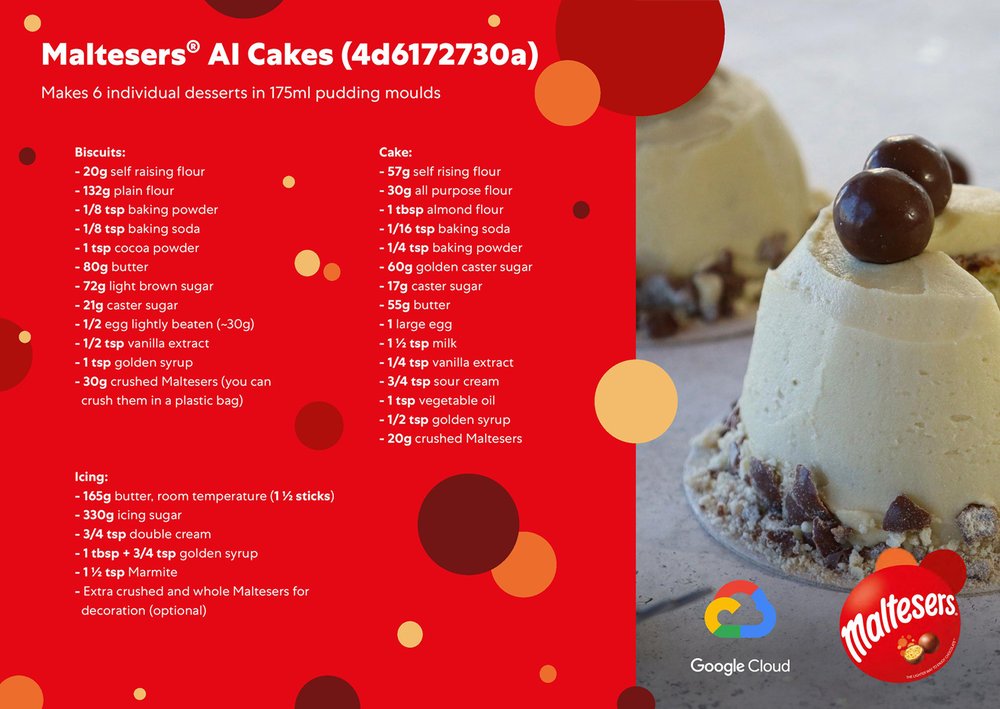
Maltesers® AI Cakes
I’m skipping a lot of the ML magic! For a technical deep dive on how the AI works, see this blog post. For baking enthusiasts, these pictures share a little more of the process. Midway through baking the cake, I added three surprise Maltesers in the middle, and a cookie layer on top (which becomes the bottom when you flip these out). Yum!
Where’s the Marmite, I hear you say!? I whipped up a Marmite-infused buttercream topping. It’s delicious! Don’t believe me? See the recipe below, give it a whirl and let me know what you think. Share photos on Twitter or Instagram using the hashtag #BakeAgainstTheMachine, and head over to BakeAgainsttheMachine.co.uk to learn more about this project from Mars and find more special Maltesers recipes. I can’t wait to see your creations!


Netflix punta sempre più sugli anime giapponesi
Netflix è sempre più protagonista della vita e dell’intrattenimento di milioni di appassionati di cinema e serie televisive in tutto il mondo. Per tenere testa alla concorrenza, oltre che per soddisfare la richiesta dei suoi utenti, la società che la gestisce è molto attiva nel ricercare prodotti di qualità, originali e acquisiti. Tra questi un ruolo importante lo esercitano ormai gli anime, i cartoni animati giapponesi, che proprio sulla famosa piattaforma di streaming a pagamento hanno fatto registrare lo scorso anno ascolti da record, spingendo Netflix a programmare oltre 40 nuove serie per il 2021.