When Dr. Logan Schneider was in medical school, he didn’t get much sleep. “Residency training is a horribly draining experience where you get something like…four hours of sleep a night,” he says. It was during this time he realized how little we really know about sleep.
“I started prioritizing my own sleep, and also my wife’s and my kids’ — they’re sleeping champs!” he says. (In fact, his friends with newborns often turn to him when their babies won’t sleep through the night.) Originally focusing on neurology in medical school, Logan soon became so fascinated by what he was learning about sleep that he decided to study it specifically.
Dr. Schneider is part of the Google Health team that coupled sensor research with sleep science to power contactless sleep sensing in the new Nest Hub, available beginning today. Sleep Sensing, powered by Soli technology, uses a tiny, low-energy radar system to sense motion at the micrometer level. Small motions ranging from breathing to movements are detected, while identifying features like faces aren’t, to give people information about their sleep duration, routines and quality. From this data, the Nest Hub can offer personalized suggestions like waking up at a consistent time, or exercising earlier in the day.
“When we started thinking about the second-generation Nest Hub, we noticed that nearly a quarter of people currently using Nest Hubs put their devices in their bedrooms,” says product manager Ashton Udall. “So we started to look into how we could bring more value to that part of the home.” When the Nest team surveyed users about what else they could do to make the device better for bedrooms, the top request, hands down, was for assistance with their sleep. Combined with trends showing people are getting less sleep and worse sleep, there was an obvious opportunity to help.
“It’s so exciting to be in this field right now because there are so many things we’re discovering about sleep,” says Dr. Raman Malhotra from the American Academy of Sleep Medicine, who advised the Nest team throughout the development process. What the medical field is learning about sleep isn’t the only exciting thing, though. Dr. Malhotra also says it’s the fact that technology companies are increasingly interested in democratizing sleep research and helping more and more people understand their sleep.
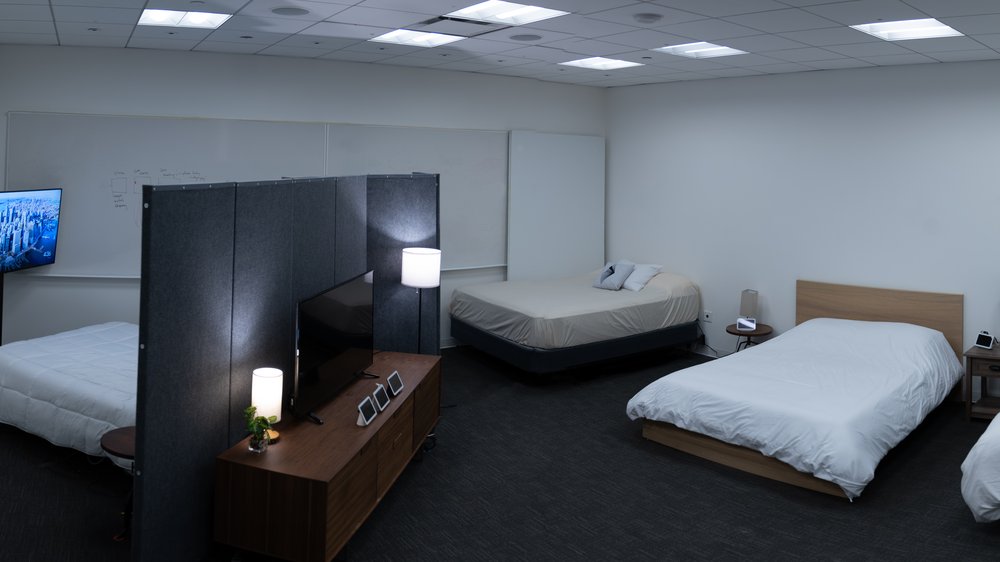
The number of combinations and permutations we tested in Forty Winks…it’s unfathomable.
For both doctors and patients, sleep is a “black box,” as both Dr. Malhotra and Dr. Schneider explain it; if you go to a doctor and say you’re not sleeping well, it’s not as if you can give much more information than that. You know how you feel the next day, but not necessarily why. “Traditionally, we’d bring someone into a sleep lab to measure their sleep with something called a polysomnogram which is the gold standard for certain sleep disorders — but the polysomnogram has limitations, too,” says Dr. Malhotra. “Most patients don’t want to leave their house for a night and go to an unfamiliar environment. Then, of course, we’re changing what their sleep looks like — who’s going to sleep normally with wires attached to them?” And even after all that, he says, it’s difficult to learn much from just one night.
“That’s what’s so exciting about new sleep technologies,” Dr. Malhotra explains. “We can learn about how someone’s sleeping in their normal environment over a whole bunch of nights, not just one.” Plus, he says, something like the Nest Hub is accessible to far more people than a polysomnogram.