How anonymized data helps fight against disease
Data has always been a vital tool in understanding and fighting disease — from Florence Nightingale’s 1800s hand drawn illustrations that showed how poor sanitation contributed to preventable diseases to the first open source repository of datadeveloped in response to the 2014 Ebola crisis in West Africa. When the first cases of COVID-19 were reported in Wuhan, data again became one of the most critical tools to combat the pandemic.
A group of researchers, who documented the initial outbreak, quickly joined forces and started collecting data that could help epidemiologists around the world model the trajectory of the novel coronavirus outbreak. The researchers came from University of Oxford, Tsinghua University, Northeastern University and Boston Children’s Hospital, among others.
However, their initial workflow was not designed for the exponential rise in cases. The researchers turned to Google.org for help. As part of Google’s $100 million contribution to COVID relief, Google.org granted $1.25 million in funding and provided a team of 10 fulltime Google.org Fellows and 7 part-time Google volunteers to assist with the project.
Google volunteers worked with the researchers to create Global.health, a scalable and open-access platform that pulls together millions of anonymized COVID-19 cases from over 100 countries. This platform helps epidemiologists around the world model the trajectory of COVID-19, and track its variants and future infectious diseases.
The need for trusted and anonymized case data
When an outbreak occurs, timely access to organized, trustworthy and anonymized data is critical for public health leaders to inform early policy decisions, medical interventions, and allocations of resources — all of which can slow disease spread and save lives. The insights derived from “line-list” data (e.g. anonymized case level information), as opposed to aggregated data such as case counts, are essential for epidemiologists to perform more detailed statistical analyses and model the effectiveness of interventions.
Volunteers at the University of Oxford started manually curating this data, but it was spread over hundreds of websites, in dozens of formats, in multiple languages. The HealthMap team at Boston Children’s Hospital also identified early reports of COVID-19 through automated indexing of news sites and official sources. These two teams joined forces, shared the data, and published peer-reviewed findings to create a trusted resource for the global community.
Enter the Google.org Fellowship
To help the global community of researchers in this meaningful endeavour, Google.org decided to offer the support of 10 Google.org Fellows who spent 6 months working full-time onGlobal.health, in addition to $1.25M in grant funding. Working hand in hand with the University of Oxford and Boston Children’s Hospital, the Google.org team spoke to researchers and public health officials working on the frontline to understand real-life challenges they faced when finding and using high-quality trusted data — a tedious and manual process that often takes hours.
Upholding data privacy is key to the platform’s design. The anonymized data used at Global.health comes from open-access authoritative public health sources, and a panel of data experts rigorously checks it to make sure it meets strict anonymity requirements. The Google.org Fellows assisted the Global.health team to design the data ingestion flow to implement best practices for data verification and quality checks to make sure that no personal data made its way into the platform. (All line-list data added to the platform is stored and hosted in Boston Children’s Hospital’s secure data infrastructure, not Google’s.)
Looking to the future
With the support of Google.org and The Rockefeller Foundation, Global.health has grown into an international consortium of researchers at leading universities curating the most comprehensive line-list COVID-19 database in the world. It includes millions of anonymized records from trusted sources spanning over 100 countries.
Today, Global.health helps researchers across the globe access data in a matter of minutes and a series of clicks. The flexibility of the Global.health platform means that it can be adapted to any infectious disease data and local context as new outbreaks occur. Global.health lays a foundation for researchers and public health officials to access this data no matter their location, be it New York, São Paulo, Munich, Kyoto or Nairobi.

Server bare metal: cos’è, quali caratteristiche e come sceglierlo
Un server bare metal è un tipo di server dedicato che prevede l’affitto di una macchina fisica da un provider da parte di un utente, la quale non viene condivisa con altri soggetti. La principale differenza con i tradizionali servizi condivisi è che i bare metal permettono all’utente il completo controllo dell’infrastruttura, tanto da poter sceglierne anche il sistema operativo. Dunque, il bare metal server si propone come soluzione ideale per chi vuole evitare di…
L’articolo Server bare metal: cos’è, quali caratteristiche e come sceglierlo scritto da YOUR_DIGITAL_VOICE! proviene da Assodigitale.
Query cross-database in SQLite
GameSnacks brings HTML5 games to Google products
Last February we announced GameSnacks, a HTML5 gaming platform from Area 120, Google’s workshop for experimental products. We launched GameSnacks to test whether lightweight, casual games would resonate with people who use the internet via low memory devices on 2G and 3G networks, especially in countries like India and Indonesia.
Since then, millions of people from around the world have played our games. GameSnacks now has more than 100 games built by early game development partners. These games span multiple genres: classics (e.g. Chess), racing games (e.g. Retro Drift), puzzle games (e.g. Element Blocks), and hypercasual games (e.g. Cake Slice Ninja) to list a few. You can check out the full catalog by visiting gamesnacks.com.
Today, we’re sharing how we’ve broadened our efforts by bringing HTML5 games to Google products. We’re also inviting more game developers to join us as we grow the platform.
Finding HTML5 games to play is hard
When I mention HTML5 web gaming to friends and family, they fondly remember Flash gaming sites from 10 or 15 years ago. Web games have come a long way since then. Mobile browsers can now render rich graphics, and engines like Phaser, Construct and Cocos make it easier for developers to build HTML5 games.
HTML5 games tend to be small, enabling them to load quickly in a variety of network conditions, whether on 2G near the outskirts of New Delhi or on an intermittent connection on a New York City subway. Users can play them on any device with a web browser: Android, iOS, and desktop. And across these devices, users don’t need to install anything to play. They simply tap on a link and start playing games immediately.
However, the distribution landscape for HTML5 games is fragmented. Developers have to painstakingly modify their HTML5 games to work across each app they integrate with or web portal they upload to. Discovering HTML5 games to play is often difficult.
We’ve been thinking about how we can make HTML5 game developers’ lives easier to ultimately get more HTML5 games out to more users. Here’s a closer look at how we’re doing this.
A new way to discover HTML5 games across Google products
Back in February 2020, we announced our partnership with Gojek to bring HTML5 games to their users and give developers a new distribution opportunity. Since then, we’ve been bringing the GameSnacks catalog to users across a variety of different Google apps.
First, we’ve made it easy to access GameSnacks games directly from the New Tab page in Chrome, starting with users in India, Indonesia, Nigeria and Kenya. Users can get to gamesnacks.com via the Top Sites icon on Chrome on Android. The Games section is one of the most frequently visited sections of the page.
Your Android is now even safer — and 5 other new features
It wasn’t all that long ago that we introduced Android users to features like Emoji Kitchen and auto-narrated audiobooks. But we like to stay busy, so today we’re highlighting six of the latest Google updates that will make Android phones more secure and convenient — for everyone.
1. Keep your accounts safe with Password Checkup on Android
How one trailblazer uses Maps to explore the outdoors
Lydia Kluge is an active member of the Google Maps Local Guides community, the everyday people passionate about sharing their experiences on Maps. In 2020, she added more than 1,100 contributions on Google Maps in the form of reviews, photos, and places. Coincidentally, Lydia also hiked, ran, and biked 1,100 miles last year. All those adventures earned her the well-deserved Expert Trailblazer and Expert Fact Finder badges on Google Maps.
But Lydia’s journey has been full of adventures long before 2020. Originally from England, Lydia landed in Utah in 2005 for what was meant to be a six-month stint as a ski instructor. She’s been there ever since after falling in love with (and on) the slopes where she met her now-husband.
Over the past fifteen years, the couple traveled to over 30 countries. Along the way, Lydia used Google Maps to find hidden gems — from the best restaurants in Paris to snorkeling spots in Australia.
In 2019, Lydia and her husband welcomed their beautiful baby girl into their family and couldn’t wait to travel with her. But COVID-19 changed their international jet-setting plans. Like many of us, Lydia’s spending more time closer to home. She’s explored Utah’s mountains, deserts, and national and state parks. And, just like in her international travels, Google Maps has been her companion. She’s added and reviewed dozens of nature trails, trailheads, and parks, and created lists of family-friendly activities in Utah. “One thing I’ve missed about working outside of the home is how I can contribute to others and my community,” Lydia said. “Adding these things to Google Maps is a way I can give back.”
Here are Lydia’s tips on how to use Google Maps to explore natural attractions near you:
Find parks and hiking trails on Google Maps
Search outdoor terms like “hiking trails” or “parks near me” to find nearby treks. For most hiking trails, you’ll be able to find ratings, reviews and photos from other hikers. Some may also have useful details like open hours and phone numbers. You can also use the Lists feature on Google Maps to see curated recommendations, like Lydia’s Things to See and Do in St. George and Food and Fun in Park City. Simply search for a town and scroll down to see Featured Lists.
Our all-new TalkBack screen reader
To blind traveling bluesman Joshua Pearson, songwriting is more than just a good melody. “Songwriting gave me a language to talk about my frustrations. And by putting my music out there, I could hopefully let somebody else feel some of what I was feeling.” For Joshua, TalkBack is his main pen and paper for writing songs; it lets him dictate lyrics into his phone and hear them told back to him.
Screen readers, such as Android’s TalkBack, are the primary interface through which Joshua and many other people who are blind or low vision read, write, send emails, share social media, order delivery and even write music. TalkBack speaks the screen aloud, navigates through apps, and facilitates communication with braille, voice and keyboard input. And today we’re releasing an all-new version of TalkBack that includes some of the most highly requested features from the blind and low vision community.
Tap as you please with multi-finger gestures
We’ve added a dozen easy-to-learn and easy-to-use multi-finger gestures that are available with the latest version of TalkBack on Pixel and Samsung Galaxy devices from One UI 3 onwards. These gestures make it easier for you to interact with apps and let you perform common actions, such as selecting and editing text, controlling media and finding help.
We worked closely with people in the blind and low vision community to develop these easy-to-remember gestures and make sure they felt natural. For example, instead of navigating through multiple menus and announcements to start or stop your favorite podcast, it’s now as simple as double tapping the screen with two fingers.
Read or skim with just a swipe
Reading and listening is easier with new controls that help you find the most relevant information. For instance, you can swipe right or left with three fingers to hear only the headlines, listen word-by-word or even character-by-character. And then with a single swipe up or down you can navigate through the text.
Say what? There’s new Voice Commands
Starting with TalkBack 9.1, you can now swipe up and right to use TalkBack’s new voice commands. TalkBack will stop talking and await your instructions. With over 25 different commands, you can say “find” to locate text on the screen or “increase speech rate” to make TalkBack speak more quickly.
Do things your way with more customization and language options
While we put a lot of thought into this redesign, one thing we’ve learned from working with the community is that everyone interacts with their phones in their own way — which makes customization important. You can now add or remove options in the TalkBack menu or reading controls. Additionally, gestures can be assigned or reassigned to scores of settings, actions and navigation controls.
Lastly, we’re adding support for two new languages in TalkBack’s braille keyboard: Arabic and Spanish.
Joining forces for accessibility
The all-new TalkBack is the result of our collaboration with trusted testers and Samsung, who co-developed this release. TalkBack is now the default screen reader on all Samsung Galaxy devices from One UI 3 onwards, making it easier to enjoy a consistent and productive screen reader experience across even more devices.
To help everyone keep up with all the changes, we’ve created an entirely new tutorial to make it easier to make the most of TalkBack — there’s even a test pad to practice new gestures. With these new features and collaborations we hope that more people can find useful and creative ways to use TalkBack. Who knows, you might even find lyrical inspiration like Joshua.

Videoconferenze: semplicità e sicurezza con Barco ClickShare

Disney+ accoglie Star: prezzo più alto da oggi
Disney+ introduce Star tra i suoi contenuti: si tratta di una sottosezione della piattaforma streaming che porta nel catalogo produzioni rivolte perlopiù a un pubblico di adulti. Di conseguenza, il prezzo del servizio vede un rincaro di 2 euro al mese: per abbonarsi, quindi, saranno necessari 8,99 euro mensili o 89,90 all’anno.
Problem Solved: Increase B2B Content Marketing Success by Conquering 4 Conundrums

In his recently-published book, What’s Your Problem: Become a Better B2B Marketer by Enhancing Your Problem-Solving Skills, Steve Goldhaber argues that the discipline of content marketing boils down to a simple consistent objective: solving problems.
It’s a reasonable framing. Almost every piece of marketing content is essentially aimed at solving a problem. This really gets to the fundamental intent of B2B content marketing as a practice: by helping our audience solve day-to-day problems and overcome business challenges, we hope that they’ll eventually consider using our product or service to solve a bigger problem.
But content marketers can’t focus solely on solving problems for customers. We also need to look inward and address key challenges that threaten the value and impact of our problem-solving content. The old saying about “getting your own house in order” comes to mind.
Here’s a look at four prevalent conundrums faced by B2B content marketers today, and how I recommend confronting and conquering them.
How to Overcome 4 Vexing B2B Marketing Conundrums
Content marketers need to reckon with these stumbling blocks before they can race to big success with their strategies.
Conundrum #1 ? More brands and platforms than ever are competing for the diminishing currency of attention.
On the surface, it seems like a clear positive: Fueled by social distancing and a lack of in-person experiences, audiences flocked online more than ever in 2020. Usage of mobile devices and social media apps has risen dramatically. In theory, this means it should be easier than ever to attract eyeballs and engage users via digital marketing.
So, why the conundrum?
Two reasons. First: every brand and content-creating entity is aware of this trend, so there’s been a widespread increase in supply to meet the demand. That means more competition. Second (and not unrelated), audiences are fatigued after a year of being necessarily glued to their screens. Without question, it’s growing more difficult to earn and sustain someone’s attention, not to mention drive action and engagement.
What To Do?
It has never been more important to adopt a quality-over-quantity approach. Zero in on a narrowly defined audience whose problems you can help solve. Create highly focused and directly relevant content. Personalization holds the key to breaking through with a clear message in an online environment full of buzzing static.
[bctt tweet=”“Personalization holds the key to breaking through with a clear message in an online environment full of buzzing static.” @NickNelsonMN #B2Bmarketing #personalization” username=”toprank”]Of course, the heightened competition also calls for a re-emphasis on capturing the attention of a scrolling user. Go against the grain and deliver something your audience isn’t expecting. Rock the boat in a sea of sameness.
Our clients at LinkedIn Marketing Solutions recently shared tips for thumb-stopping content that catches a user mid-scroll and invites engagement, including examples. I especially like the bear ad example from eCornell.
Conundrum #2 ? Measuring results is difficult when direct links to revenue aren’t always clear or straightforward.
During times of economic duress, there is a natural inclination for businesses to scale back on discretionary spending. In its early days, content marketing was often viewed as discretionary, or a complementary aspect of business development. While that perception has generally changed, marketing leaders still can face an uphill battle when vying for a fair share of reduced budgets.
What To Do?
The connection between content marketing and revenue is not as overt or direct as some other investments, that’s true. But it is undeniable. The ability to map content to revenue is becoming a key asset for marketing departments, and in some cases it may require rethinking conventions.
For example, some organizations need to slow down their campaign measurement, to align with a complex and lengthy buying cycle. Another opportunity: refining attribution methods to deliver more clarity and comprehensiveness. Do you track user actions across channels? Are you accounting for both post-click and post-view conversions? Are you quantifiably measuring brand awareness and engagement? If not, these are worthy aspirations in a results-oriented business landscape.
Conundrum #3 ? It’s tough to authentically integrate influencers into content when audiences are suspicious of brand sponsorships.
Influencer marketing is a broadly-applied term, and in some applications it can feel a little sketchy. When people relate the concept with Kylie Jenner shilling for Pepsi in a tone-deaf Super Bowl ad, or Instagram celebrities promoting a disastrous tropical festival, it’s understandable how they’d become skeptical. The credibility gained by associating your brand with a respected figure is negated (and then some) when the influencer isn’t genuinely interested or invested.
When done right, influencer marketing is highly effective. But more than ever, marketers need to be strategic, and mindful of optics.
[bctt tweet=”“When done right, influencer marketing is highly effective. But more than ever, marketers need to be strategic, and mindful of optics.” @NickNelsonMN #B2Bmarketing #personalization” username=”toprank”]What To Do?
It all starts with selecting the right influencers. Identify voices with strong topical and audience alignment. Aim to be more relationship-based than transactional in your partnerships. Deliver clear value to the people you work with to spur enthusiastic participation. Co-create content and find interesting ways to incorporate influencers’ expertise, perspectives, and stories.
Above all, make transparency a fixture. You don’t want your audience left to wonder about the motivations of people involved — or worse yet, feel misled.
Conundrum #4 ? Fast-rising new channels don’t have obvious applicability for B2B marketing purposes.
When glancing at recent trends and stats in content marketing, it’s hard not to notice the meteoric rise in usage of apps like TikTok and WhatsApp. Brands are gravitating toward Instagram Stories.
These channels are intriguing, but they don’t intuitively have much applicability in B2B marketing.
What To Do?
The last thing you want to do is jam a square peg in a round hole for the sake of seeming cool or hip. But that’s not to say there aren’t creative and contextually-fitting ways to market a B2B brand on B2C-centric platforms. Doing so effectively is an opportunity to stand out and differentiate, in accordance with our solution to Conundrum #1.
[bctt tweet=”“Finding creative and contextually-fitting ways to market a #B2B brand on B2C-centric platforms is an opportunity to stand out and differentiate.” @NickNelsonMN #B2Bmarketing #personalization” username=”toprank”]For inspiration, courtesy of PixelMe, here are 10 creative Instagram ads from B2B companies (led off by our clients at monday.com).
Break Down B2B Content Marketing Barriers
Both challenge and opportunity can be found within each of the conundrums presented. Those B2B marketers who take the right steps to solve them will enjoy a more smooth and frictionless path to success.
Keep four things top-of-mind as you venture ahead:
- Create with a purpose (and flair)
- Measure robustly
- Partner strategically
- Experiment away from the beaten path
For more advice on overcoming obstacles to resonate with your audience, check out my recent post on five B2B content marketing pitfalls to avoid.
The post Problem Solved: Increase B2B Content Marketing Success by Conquering 4 Conundrums appeared first on B2B Marketing Blog – TopRank®.
Updates on Google Health’s clinical tools
Healthcare professionals are healers, not data clerks. Yet many clinicians spend half their day on a computer navigating electronic health records (EHRs) and other systems. Because health records are often scattered across multiple systems, getting a full picture of a patient’s health requires a great deal of clinicians’ time, energy, and resources. These gaps in patient information can contribute to less effective and efficient care. The Google Health team started to think about how we could bring Google’s experience in organizing complex information to healthcare.
Driven by this idea, we created Care Studio, a software solution that provides a comprehensive view of a patient’s records and allows clinicians to quickly search through complex patient information. Care Studio is built for clinicians and works alongside EHR systems; it streamlines workflows and supports more proactive care. We’ve been working with the healthcare organization Ascension on a pilot of Care Studio focused on data quality and product safety with a small group of clinicians based in Nashville, TN and Jacksonville, FL. The pilot is now expanding to more physicians and nurses in the clinical setting.
How Care Studio supports clinicians
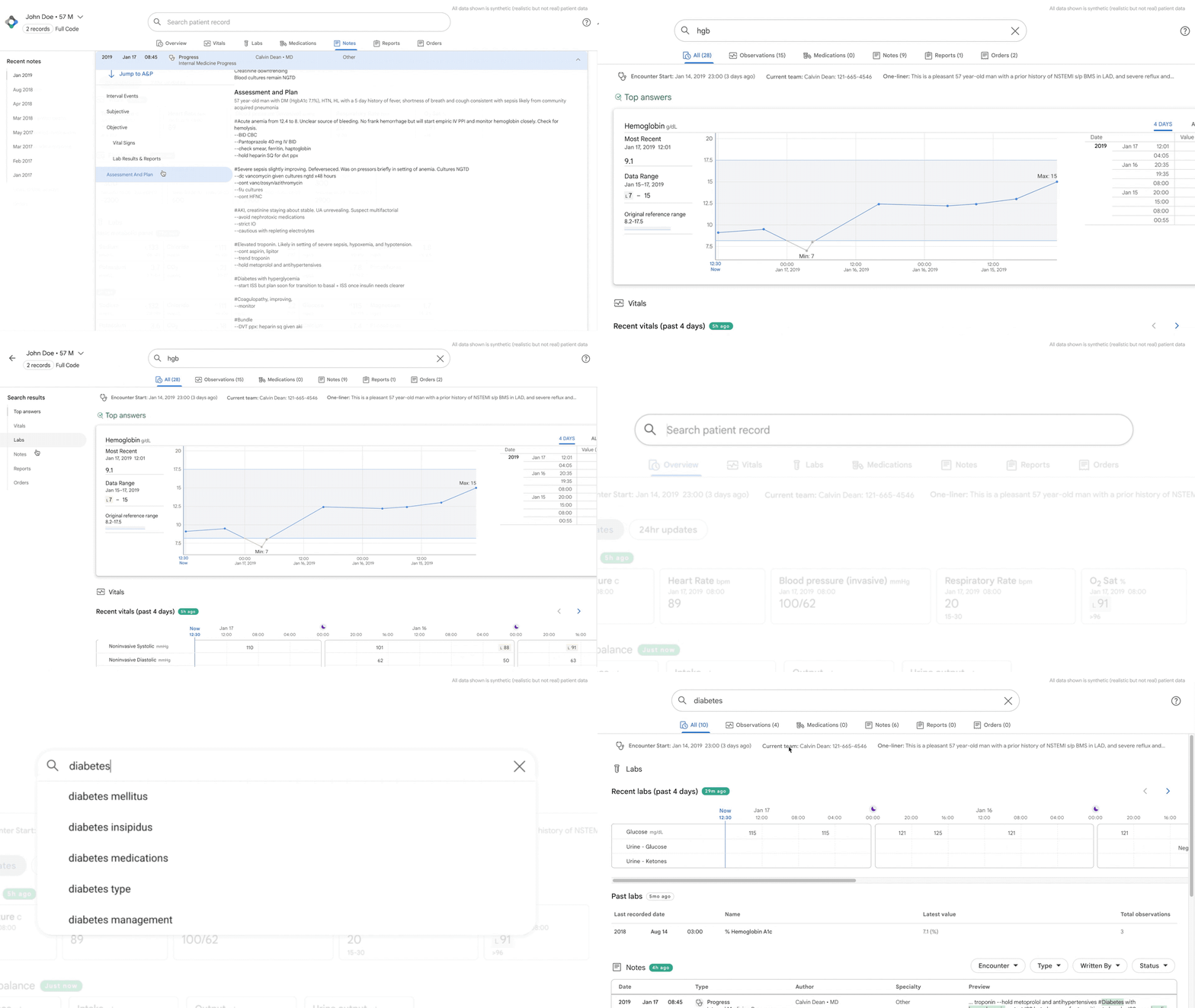
Care Studio streamlines key clinician workflows so that teams can quickly get the information they need to care for patients. It brings together patient records from the multiple EHRs an organization uses – giving clinicians a centralized view of patient data and the ability to search across these records.
We’ve honed our search capabilities based on medical terminology and clinical shorthand, so that clinicians can simply type what they’re looking for into a search bar and instantly surface relevant patient record information. Still, a patient’s history can be long and complex, making important details difficult to find. Care Studio uses Google technology to display relevant information in fewer clicks. For example, Care Studio can automatically organize the medications in a patient’s history with information on dosing and when they were prescribed. The tool also makes it easy to find pertinent information, including lab results, procedure orders, medication orders and progress notes.
Care Studio harmonizes medical data across different systems. For example, even though health systems report measurements like blood pressure or glucose levels using different units, Care Studio automatically converts them so they are easier for a clinician to understand and compare.
Search using clinical shorthand or everyday language. All data shown is synthetic (realistic but not real) patient data.
Keeping health information private and secure
We know healthcare data is sensitive and personal, and it’s our responsibility to keep it private and secure. Google does not own, nor do we ever sell, patient data. This data from Care Studio cannot be used for advertising. Our team designed Care Studio to adhere to industry best practices and regulations, including HIPAA.
We implement administrative, technical and physical safeguards to protect information. Patient data is encrypted and isolated in a controlled environment, separate from other customer data and consumer data. Consistent with industry best practices, we also participate in regular audits and external certifications such as ISO 27001 and SOC2/3, where auditors validate Care Studio’s processes for safeguarding customer data. With these certifications, third-party specialists make sure we follow a framework of controls for a comprehensive and continually evolving model for managing security.
Taking our next step toward clinical impact
Based on feedback from Ascension, we’ve fine tuned Care Studio so it displays relevant clinical information from their systems accurately and in a way that’s useful to their physicians and nurses. Now we’re ready to expand our pilot in the clinical setting to further optimize the product for broader usage at Ascension. A select group of clinicians at facilities in Nashville, TN and Jacksonville, FL will use an early release of Care Studio alongside their existing tools during care delivery. We hope to get their feedback to further improve its usability, make the tool more useful to them and better integrate into current workflows.
Our aim is to bring Google’s experience in organizing complex information into intuitive, useful formats for the healthcare industry. As more Ascension clinicians begin using Care Studio, we look forward to supporting them in caring for their patients.

Il Fatto Quotidiano annuncia la morte segreta del Principe Filippo. Da un anno
Da un anno, ormai, sul sito del Fatto Quotidiano c’è un articolo a firma di Januaria Piromallo, che dà per morto il Principe Filippo. “La mia fonte molto, molto vicino a Buckingham Palace è autorevole”, scrive Piromallo il 26 marzo 2020: sì, duemilaventi. Poco importa, a quanto pare, che il principe Filippo sia stato poi visto in giro in buona salute. Meno male che Piromallo precisa che “il rischio che potesse essere anche una fake news mi ha portato alla prudenza e a non pubblicare niente.”
L’articolo non è stato corretto o rettificato. Copia permanente: https://archive.is/qggy8.
Ripeto, questo screenshot è di marzo 2020:

Sul Fatto Quotidiano c‘è anche un altro articolo di un anno fa (25 marzo 2020) che riporta la stessa notizia falsa, stavolta firmata da “F.Q.”. Copia permanente: https://archive.is/Dv8DN.

Però mi raccomando, le fake news sono colpa di Internet.
Questo articolo vi arriva gratuitamente e senza pubblicità grazie alle donazioni dei lettori. Se vi è piaciuto, potete incoraggiarmi a scrivere ancora facendo una donazione anche voi, tramite Paypal (paypal.me/disinformatico), Bitcoin (3AN7DscEZN1x6CLR57e1fSA1LC3yQ387Pv) o altri metodi.

Spotify Hi Fi: entro fine 2021 la qualità audio dei CD
Spotify imita Amazon Music e annuncia entro l’anno il supporto Hi Fi. La comunicazione è avvenuta da parte della stessa piattaforma musicale durante il suo evento virtuale in streaming Stream On. Spotify Hi-Fi, in sostanza, ripropone nel formato audio lossless la qualità audio dei Cd musicali che sono stati quasi del tutto soppiantati dai formati digitali. Il servizio sarà disponibile entro la fine del 2021, ma inizialmente solo in alcuni mercati selezionati. Si tratta sostanzialmente di un allineamento da parte di Spotify verso quei servizi che già offrono musica ad alta fedeltà.

Come ottenere Amazon Music HD gratis per 3 mesi
Sono passati ormai sei mesi dall’arrivo in Italia di Amazon Music HD, il servizio di streaming musicale di Amazon pensato per chi punta ad avere il massimo della qualità audio con milioni di brani in definizione ultra HD, e oggi Amazon ha deciso di dare a tutti la possibilità di toccare con mano questa novità offrendo tre mesi di prova gratuita.

Amazon Fresh arriva anche a Roma
A neanche un mese dal suo arrivo in Italia, Amazon Fresh sbarca anche a Roma a partire da oggi. Disponibile direttamente su Amazon.it – non come Prime Now, che ha un sito a parte e permette di fare la spesa online con prodotti in arrivo anche da supermercati di terze parti – Amazon Fresh ci permette di fare la spesa comodamente da casa scegliendo tra oltre 10.000 prodotti in decine di categorie diverse, con una particolare attenzione, come si evince dal nome del servizio, ai servizi freschi come carne, pesce, frutta e molto altro.