
Cashback di Natale non rimborsato? Come fare reclamo
I rimborsi per il Cashback di Natale sono stati completati, ma c’è ancora tempo per presentare un reclamo. Consap, l’ente incaricato dal governo di erogare il bonus ai cittadini, ha comunicato nei giorno scorsi che “nel pieno rispetto delle scadenze previste si è conclusa la fase di liquidazione dei rimborsi per il periodo 8-31 dicembre 2020″: più di 3,2 milioni di bonifici per un totale liquidato di circa 223 milioni di euro.

Google, il cavo di rete sottomarino diventa un sensore sismico
Sono circa tredici i cavi sottomarini che Google ha realizzato privatamente o in collaborazione con altre aziende per collegare e incrementare la crescita di Google Cloud. Tra questi c’è Curie (dedicato a Marie Curie, Nobel per la fisica nel 1903) che collega Los Angeles e il Cile. Inaugurato nel 2019, è lungo circa 10.000 chilometri ed è situato a una profondità tra i 4 e i 6 chilometri. Proprio per la loro posizione e per la caratteristica tipica dei cavi sottomarini in fibra ottica di essere sensibili alle variazioni di temperatura e alla pressione delle onde, si sono rivelati utili nel registrare eventi sismici e tsunami.

Elon Musk indagato dalla SEC per i tweet su Dogecoin?
Di nuovo guai per Elon Musk. Secondo quanto riportato dal quotidiano finanziario First Squawk, il CEO di Tesla sarebbe nuovamente finito nel mirino della Security and Exchange Commission (SEC), l’ente governativo statunitense che si preoccupa di vigilare sui mercati finanziari, a causa di una presunta manipolazione del mercato delle criptovalute per i suoi commenti a favore di Dogecoin, la valuta digitale nata per scherzo nel 2013 come “meme” in onore del Doge, ma che è arrivata per un periodo ad avere un capital market di circa 2 miliardi di dollari.

Facebook: nuova sfida a TikTok con BARS
Facebook continua a lavorare nella direzione di TikTok. Il social network di Mark Zuckerberg ha reso disponibile una nuova app, seppur solo all’interno dei confini degli USA, con lo scopo di “rosicchiare” ulteriori quote di mercato all’app cinese. Si chiama BARS e al momento è stato distribuita in closed beta ad una cerchia ristretta di possessori di dispositivi iOS. Come lo stesso nome dell’app suggerisce, si tratta di un software incentrato sul rap. Sono proprio le barre, dunque, l’unità di misura per definire la durata di una strofa.

Da HTTP ad HTTPS con WordPress 5.7

Furthering our work with HBCUs

Puntata del Disinformatico RSI del 2021/02/26
È disponibile la puntata di stamattina del Disinformatico della Radiotelevisione Svizzera, condotta da me insieme a Tiki. Grandi novità bollono in pentola: ve ne parlerò da metà marzo. La puntata di venerdì prossimo salta per fare spazio a Sanremo. A 56:00 circa salgo cautamente sul mio skateboard classe 1980 :-)
Argomenti trattati:
- La “truffa alla nigeriana” è un classico. Un classico del sedicesimo secolo
- Video, foto e audio stupefacenti da Marte: l’atterraggio di Perseverance
- Hai dimenticato la password? Nessun problema: questo sito di e-commerce italiano non la controlla
- Le parole di Internet: necroposting
- Come difendersi da un robot di Boston Dynamics
Podcast solo audio: link diretto alla puntata; link alternativo.
App RSI (iOS/Android): qui.
Video (con musica): è qui sotto.
Podcast audio precedenti: archivio sul sito RSI, archivio su iTunes e archivio su TuneIn, archivio su Spotify.
Archivio dei video precedenti: La radio da guardare sul sito della RSI.
Buona visione e buon ascolto!

Honor MagicBook Pro: la nuova versione ha CPU Intel

For Rich Jones, starting a finance podcast just made cents
In this post: Rich Jones, who works in people operations at Google, is the host of a personal finance podcast called “Paychecks & Balances.” He hopes his show can help people learn from his mistakes — and now he’s helping others start podcasts, too.
Several years ago, Rich Jones was on the hunt for personal finance podcasts. But none were right for him. “It felt like every podcast that I listened to either made me feel dumb, or made me feel like I was being lectured by an old white guy in a suit,” he says. “Or it just was really boring.” So he decided to create his own.
These days, his podcast, “Paychecks & Balances,” has been downloaded more than two million times and recently won an award from the Plutus Foundation, which highlights excellence in financial media. He often records episodes from his Mountain View home in the early-morning hours, then logs on for his job working in People Operations at Google.
For years, Rich has turned to the internet to express himself. But even though his name is, well, Rich, he didn’t first think of money as a topic to talk about. In fact, he had first blogged about relationships for several years, and then co-hosted a podcast called “2 Guys, 1 Show,” that was about more general topics, including money.
Rich realized that if he felt lectured by finance podcasters, other people like him — and possibly younger people learning about money for the first time — likely felt the same way. So he and his co-host decided to focus on finances and rename the podcast “Paychecks & Balances.” They wanted to reach out to younger versions of themselves — and Rich also wanted to represent people like him as well as reach them. “Even now, you won’t find a whole lot of Black men in the personal finance space in particular,” he says. “I think it’s important to be out there as a Black male and show a perspective that you might not be getting elsewhere.”
For the current season of the show, Rich is hosting the show solo, and he’s continuing to share his own financial progress while also teaching others. When he started the show, he was grappling with credit-card debt after treating his cards like “free money.” Because of his experience, he knows to talk about money in a way that’s relatable and simple, for people just starting to manage their finances. “I don’t call myself an expert,” he says. “Podcasting is a medium for me to talk about my experience. And not just my successes, but the mistakes I’ve made along the way as well.”
It felt like every podcast that I listened to either made me feel dumb, or made me feel like I was being lectured by an old white guy in a suit.
Rich is constantly surprised that he keeps getting the same questions over and over — like how to balance a budget, or why not to sign up for a credit card in exchange for a free T-shirt. And over the past year, he’s seen friends fall prey to get-rich-quick scams and even try to sign him up. Rich says this is a symptom of a lack of financial education. “The interesting problem to me is: How do we close that gap where this information feels accessible to everyone, and people are accessing that information a lot sooner?” he says.
With the growth of his podcast, Rich says people have come to him asking for advice on starting their own podcasts. So this month he launched a YouTube page, The Show Starter, which breaks down advice for people who might not have a technical audio background. “It’ll be a combination of tutorials, reviews and some motivational content, but not the cheesy, corny kind,” he says. “It’s very similar to the approach I take with personal finance topics, where I try to simplify things as much as possible and take out the jargon.” He hopes to one day expand his work into a multimedia company, with multiple brands under the “Paychecks & Balances” umbrella.
B2B Marketing News: Trust Tops Brand Marketer Study, Top Email Engagement Day Shifts, YouTube’s New Comparative Data, & Ad Prices Rise
Brand marketers stick to trust-building strategies forged in 2020’s fires, study finds
91 percent of brand marketers will keep focusing on the strategies aimed at building trust they developed in 2020 as a response to the pandemic, according to recently-released survey data of interest to digital marketers. Marketing Dive
Ad Prices Forecast To Inflate 3% This Year
Digital display ad price inflation for 2021 is expected to be 3.4 percent, with digital video slightly higher at 3.6 percent, while this year is expected to hold some recovery from the impact of the pandemic in 2020, according to newly-released forecast data. MediaPost
In Engagement Shift, Friday Proves Top Day for Email Response Rates in 2020
With an 18.9 percent click-to-open (CTO) rate, marketing emails sent on Friday lead the way when it comes to engagement levels, according to recently-released survey data, with Saturday coming in as having the lowest engagement rates. MarketingCharts
YouTube Adds New Comparative Data Tools in YouTube Studio, and Info on Other Channels Your Audience Watches
Google’s YouTube platform has launched new features that allow digital marketers to compare the performance of their video content from between 24 hours up to 28 days, offering a new glimpse into a variety of performance metrics, the video giant recently announced. Social Media Today
Nielsen Launches Identity Sync, New Global Attribution System
Nielsen has rolled out a new global attribution system, Identity Sync, the firm’s identity-backed solution to the loss of cookie-based tracking systems, the firm recently announced. MediaPost
LinkedIn’s Developing a New Freelance Marketplace Platform to Facilitate New Opportunities
LinkedIn has been testing features which could expand on the platform’s existing ProFinder tool, adding enhanced professional freelancer connection functionality, according to an industry report. Social Media Today
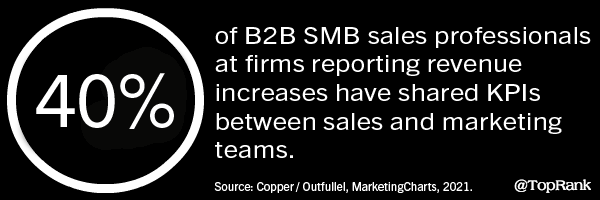
How IT Buyers’ Researching Behaviors Changed in 2020
More than 54 percent of information technology buyers spent more time researching solutions during the second half of 2020, with some 24 percent reporting research time staying flat — two of several findings of interest to digital marketers in recently-released survey data. MarketingProfs
3 Steps to Better Virtual Meetings
A clear definition of the behaviors an organization is trying to encourage will help forge more productive virtual meetings, as will finding and overcoming behavioral blockers, according to The Harvard Business Review, which recently took a look at how to make today’s online meetings more collaborative and engaging. Harvard Business Review
The Most Important Email Marketing Optimizations [Survey]
43 percent of marketers consider personalization the top characteristic to improve when it comes to email optimization, followed by data quality at 39 percent and email design at 34 percent, according to recently-released survey data. MarketingProfs
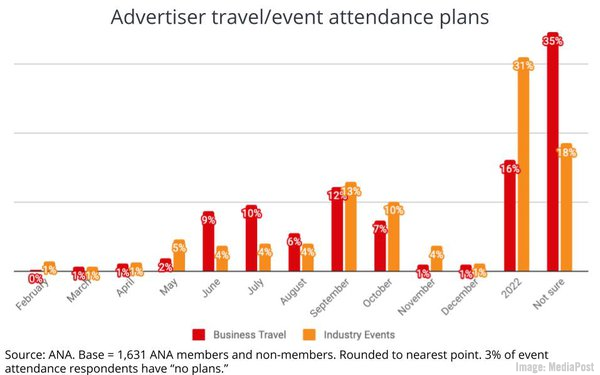
ANA Finds Half Of Ad Execs Have No Plans To Travel/Attend In-Person Events In 2021
Just 2.5 percent of advertising executives have said that they’re willing to fly for business in 2021, according to newly-released Association of National Advertisers (ANA) survey data of interest to online marketers. MediaPost
ON THE LIGHTER SIDE:

A lighthearted look at “finding your brand purpose” by Marketoonist Tom Fishburne — Marketoonist
YouTube Reveals 2020 US Bumper Ads Leaderboard of Top 6-Second Ads — Adweek
TOPRANK MARKETING & CLIENTS IN THE NEWS:
- Lee Odden — What’s Trending: Revamping Content Marketing — LinkedIn (client)
- LinkedIn / TopRank Marketing — Debunking Full-Funnel Myths that Send Marketing Strategies Off Course — LinkedIn (client)
- Joshua Nite — What Should Be Your First Steps When Starting a Business? Consider These 10 Tips — Small Business Trends
- Lee Odden — 50 Quotes That Will Change The Way You Do SEO — SERPed
Have you found your own key B2B marketing story from the past week of industry news? Please let us know in the comments below.
Thanks for joining us for the weekly TopRank Marketing B2B marketing news, and we hope that you will return next Friday for more of the most relevant B2B and digital marketing industry news. In the meantime, you can follow us at @toprank on Twitter for even more timely daily news.
The post B2B Marketing News: Trust Tops Brand Marketer Study, Top Email Engagement Day Shifts, YouTube’s New Comparative Data, & Ad Prices Rise appeared first on B2B Marketing Blog – TopRank®.

A Matter of Impact: February updates from Google.org
Editor’s note: Welcome to A Matter of Impact, Google.org’s monthly digest, where we highlight what the team’s been up to and spotlight some of the incredible nonprofits and Google.org Fellows helping solve some of society’s biggest challenges through technology and innovation.
It didn’t take long for the effects of COVID-19 to reveal a devastating, but predictable, truth: the pandemic has had an outsized impact on marginalized groups, especially people of color. At Google.org, we aim to bring the best of Google to support underserved communities. So when we made a $100 million grant and 50,000 pro bono hour commitment to support COVID-19 relief, we focused our efforts on addressing the compounding racial and social inequities of this crisis.
As we join forces to fight this pandemic, we must put equity at the center of our response and lift up our most vulnerable communities. Here you’ll find updates about our work that’s at the intersection of COVID-19 relief and equity and two themes that remain top priorities for us.
Equitable distribution of vaccines and health information
Data shows that COVID-19 affects people of color at much higher rates: about 71% percent of Black Americans and 61% of Hispanic Americans know someone who has died or been hospitalized from the virus compared to 48% of white Americans. Yet data also shows that Black Americans are getting vaccinated at lower rates than their peers. That’s why we have a team of Google.org Fellows working full-time with the Satcher Health Leadership Institute at Morehouse School of Medicine to help create a Health Equity Tracker to map and contextualize COVID-19 health disparities in communities of color throughout the U.S. We’re also committing $5 million in grants to organizations addressing racial and geographic disparities in COVID-19 vaccinations.
Support for minority-owned small businesses
Turning to the economy, reports have shown that 41% of Black-owned businesses — about 440,000 businesses — have shuttered due to COVID-19 compared to 17% of businesses owned by white people. To support minority business owners through the pandemic, we’ve supported Common Future with grant funding to provide capital and technical assistance to 2,000 women and minority small-business entrepreneurs in the U.S. We’ll also provide opportunities for Google volunteers to assist them with skill-based coaching and mentoring.
Read the rest of our Google.org updates below.
In case you missed it
Yesterday, leading academic organizations with support from a team of Google.org Fellows, shared the launch of Global.health, a data platform that helps model the trajectory of COVID-19 and future disease. Last month, we launched a Google.org Impact Challenge to help bridge the digital divide in Central and Eastern Europe, and announced $3 million in grants to help underserved communities in Kenya during a virtual summit with Sundar Pichai, CEO of Google and Alphabet, and H.E. Uhuru Kenyatta, President of the Republic of Kenya.

Twitter Super Follows: presto contenuti a pagamento?
Twitter vuole monetizzare starebbe pensando a un servizio in abbonamento che sostanzialmente porterebbe gli utenti a dover pagare per leggere i contenuti “speciali” condivisi da account ritenuti di “alto profilo”. Insomma, da microblogging a vero e proprio editore, il passo potrebbe essere breve per la piattaforma di cinguettii. Il nuovo servizio dal nome in codice Super Follows sarebbe stato presentato durante l’incontro annuale con gli investitori, sottolineando che l’obiettivo sia quelli di puntare a 315 milioni di utenti entro il 2023.

Telegram, autoeliminazione dei massaggi in tutte le chat
Le chat di Telegram stanno per diventare ancora più effimere, a patto che l’utente sia d’accordo. Negli stessi giorni in cui Whatsapp sta affrontando un calo negli utenti, complice l’introduzione dei discussi nuovi termini del servizio, Telegram sta raccogliendo insieme a Signal gli utenti che hanno deciso di dire addio al servizio di messaggistica istantanea di Facebook.

PS5, tutti gli annunci dall’evento State of Play
I prossimi mesi saranno intensi sul fronte PlayStation 5. Se è vero che la nuova console di casa Sony continua ad essere introvabile – e così sarà per tutta la prima metà di questo 2021 – i videogiochi in arrivo non soltanto per l’ultima arrivata, ma anche per PlayStation 4, saranno tantissimi. Ieri, nel corso dell’evento State Of Play, Sony ci ha dato un bell’assaggio di quello che ci aspetta.
La “truffa alla nigeriana” è un classico. Un classico dell’Ottocento
Se avete un indirizzo di mail avete ricevuto almeno una volta nella vita un messaggio contenente la classica “truffa alla nigeriana”: uno sconosciuto si presenta dicendo di essere un membro di una famiglia nobile vittima di una persecuzione e aggiungendo di avere un’ingente somma di denaro, alcuni milioni di dollari, che può recuperare soltanto con il vostro aiuto.
Il vostro nome gli è stato raccomandato da un amico che avete in comune ma che non viene nominato per prudenza. In cambio della vostra assistenza è disposto a darvi una percentuale molto consistente di quei milioni. Per avviare la procedura di recupero, però, ha bisogno che gli anticipiate una piccola somma.
La truffa è diventata particolarmente popolare in Nigeria, dove operano molti dei truffatori che la praticano. Da questa diffusione nel paese è nato il soprannome di “truffa alla nigeriana”, e dal numero della sezione pertinente del codice penale nigeriano è nato il nome alternativo di questo raggiro, ossia 419 scam.
Ma questa truffa non è affatto nata con Internet, come molti pensano.
Atlas Obscura segnala che il New York Times del 1898 (sì, milleottocento) parlava già della faccenda dicendo che era una truffa “comune” e “vecchia” che stava riemergendo. Ovviamente non c’era Internet nel 1898, per cui i truffatori comunicavano per posta cartacea.
Scrive il NYT:
“L’autore della lettera è sempre in carcere a causa di qualche reato politico. Ha sempre una grossa somma di denaro nascosta, ed è immancabilmente ansioso che venga recuperata e usata affinché qualche uomo onesto possa prendersi cura della figlia giovane e indifesa. È al corrente della prudenza e del buon carattere del destinatario della lettera tramite un amico comune, che non nomina per cautela, e gli chiede aiuto in un momento di grande difficoltà.”
In cambio, spiega il giornale, il mittente “è disposto a dare un terzo del tesoro nascosto all’uomo che lo recupererà”. Ma prima ha bisogno di ricevere una piccola somma di denaro.
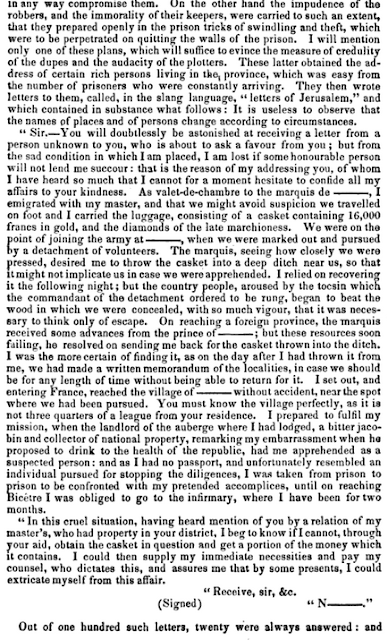
Gli ingredienti di oltre centoventi anni fa, insomma, sono gli stessi di oggi. Ma si può andare ancora più indietro nel tempo, ai primi dell’Ottocento. Eugène François Vidocq (1775-1875), uno dei padri della criminologia, racconta nelle sue memorie di quando fu condannato a otto anni di carcere per “falso in conti pubblici ed autentici”, nel 1797. In prigione vide che i carcerati scrivevano le cosiddette “lettere di Gerusalemme”, con la complicità dei carcerieri, e ne descrisse il contenuto:
Signore,
Indubbiamente lei sarà stupito nel ricevere una lettera da una persona che non conosce, che sta per chiederle un favore; ma dalla triste condizione nella quale mi trovo, sono perduto se una persona d’onore non mi presterà soccorso: questa è la ragione per la quale mi rivolgo a lei, di cui ho sentito così tante cose che non posso esitare un istante nel confidare tutti i miei affari alla sua cortesia….
La lettera standard prosegue spiegando che lo scrivente diceva sempre di essere il cameriere personale di un noto marchese che aveva dovuto abbandonare il proprio tesoro in un luogo ben occultato per evitare che finisse nelle mani dei malfattori. Il luogo era nelle vicinanze del destinatario della lettera. L‘autore della lettera spiegava che in cambio di un piccola somma si sarebbe potuto liberare dal carcere e avrebbe potuto così condurre il destinatario al tesoro per dividerselo.
Questa è la spiegazione, tratta dalla traduzione in inglese di Les Mémoires authentiques de Vidocq; non trovo online il testo dell’originale in francese.

Vidocq spiega tutto: di cento lettere di questo tipo, venti ricevevano sempre risposta. I carcerati si procuravano gli indirizzi delle persone ricche della provincia dai nuovi prigionieri. I ricchi abboccavano a questa storia improbabile, mandando a volte fino a 1500 franchi dell’epoca. E non c’era verso di far capire alle vittime che erano state raggirate: Vidocq racconta del “mercante di stoffe della Rue des Prouvaires, che fu colto a scavare sotto un arco del Pont Neuf [a Parigi], dove si aspettava di trovare i diamanti della duchessa di Bouillon”.
I secoli passano, le tecnologie cambiano, ma le debolezze umane sono sempre le stesse.